


In Part 3 of this series, we explored the science of soil health, the resilience of indigenous earthworms, and the vital importance of mulching. In this concluding part, we look at the growing success of this movement across India and the record-breaking personal results achieved by Acharya Devvrat and his colleagues.
Contents
21. Scaling the movement: The expansion of natural farming
A. Transforming Himachal’s apple orchards
When I was appointed Governor of Himachal Pradesh, I carried my agricultural expertise with me. I was troubled to find that apples, fruits synonymous with health, were being subjected to 15 or 16 chemical pesticide sprays, effectively turning them into “poison.”
I immediately launched a mission to gather farmers and advocate for change. Within just two years, and with robust government support, we successfully integrated 50,000 farmers into the natural farming movement. Today, under the guidance of experts like scientist Dr. Rajeshwar Chandel and Mr. Rakesh Kanwar (IAS), over 1.5 lakh farmers in Himachal have embraced these methods. The results are undeniable: yields have increased, water consumption has plummeted, and farmers are finally free from the debilitating health effects of chemical exposure.
B. Success in arid regions
In Andhra Pradesh, through the dedicated leadership of Chief Secretary T. Vijaykumar, over 5 lakh farmers have successfully transitioned to natural farming. The impact in water-stressed areas has been particularly revolutionary, regions that once struggled with scarcity are now harvesting three full crops a year. This remarkable turnaround is a direct result of natural techniques that restore the soil’s ability to retain every drop of moisture.
C. Rigorous academic validation
This movement is built on far more than just traditional wisdom; it is rooted in modern research. To ensure the highest standards of credibility, we have integrated numerous agricultural scientists into these projects alongside our farmers. Their findings have been rigorously documented in formal research papers, providing the empirical evidence needed to prove that natural farming is a scientifically sound and superior agricultural model.
D. Gujarat’s milestone: A national first
Even amidst the challenges of the pandemic, we successfully organised 2 lakh farmers across Gujarat and distributed an equal number of indigenous cows to support their transition. I am immensely proud to share that this collective effort has led to a historic achievement: the Dang District in Gujarat has been officially declared India’s first 100% natural farming district. This milestone serves as a blueprint for the rest of the nation to follow.
22. A vision for a renewed India
Natural farming is a solution to the world’s greatest challenges. It addresses global warming by sequestering carbon and solves the water crisis by restoring groundwater. Within 20 years, we could return to a time when water is safe to drink anywhere, and the indigenous cow, once relegated to religious paintings, is regaining her place of honour in every home, ensuring the nation’s health.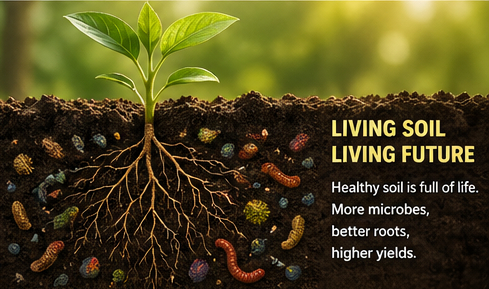
23. Economic sovereignty: Zero dependence on market inputs
The true beauty of natural farming lies in the elimination of input costs. Unlike conventional methods, there is no need for synthetic chemicals or even expensive commercial organic fertilisers. This independence effectively removes the need for massive, energy-intensive fertiliser factories and the debt cycles they often create.
Everything a farmer requires for success is already available at home: the indigenous cow, jaggery, pulse flour, and the living soil itself. By turning these local resources into potent bio-fertilisers, the farmer shifts from a consumer to a self-reliant producer.
24. The unique biological power of indigenous breeds
To ensure the success of this movement, we must remain faithful to the original method. Substituting the dung of buffaloes or foreign breeds, such as Jersey cows, will not yield the same transformative results. The specific, highly-concentrated beneficial microbes required for true soil vitality are found exclusively in the dung of indigenous (Desi) cows.
Our research has yielded fascinating insights: while we found 300 crore microbes per gram in the dung of stall-fed Desi cows, the dung of “stray” or non-milking Desi cows contained a staggering 500 crore microbes per gram. This is because their biological energy is directed entirely toward microbial production rather than milk. These “silent workers” are the true engine behind natural farming.
25. Proven results: Superior yields at minimal cost
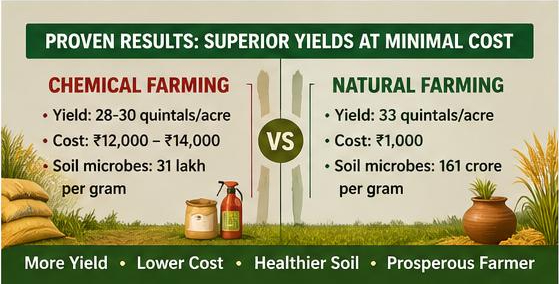
The result from my own farm is undeniable. This year, while my neighbours using chemical-intensive methods harvested 28 to 30 quintals of rice per acre, they incurred production costs of ₹12,000 to ₹14,000. In stark contrast, by employing natural farming, I harvested 33 quintals per acre, with an input cost of only ₹1,000.
The biological health of the soil tells an even more compelling story. When scientists conducted comparative soil tests, the chemical-laden farm contained 31 lakh microbes per gram. My natural farm, however, thrived with a staggering 161 crore microbes per gram. The data speaks for itself: natural farming is not just an alternative; it is a more productive and profitable reality.
26. A call to action: Detoxifying Mother India
I urge the farmers of India to join this revolution. Our Honourable Prime Minister has taken a monumental step in promoting natural farming for the collective welfare of our nation. When our farmers achieve true self-reliance, India itself becomes self-reliant.
Let us transform this movement into a nationwide “People’s Campaign” (Jan Andolan) and work together to restore the purity of our motherland. By committing to these natural practices, we can ensure a toxin-free future for generations to come.
– Acharya Devvrat
 How to cultivate vital medicinal plants at home ? Part – 2
 How to cultivate vital medicinal plants at home ? Part – 1
 A seasonal guide to traditional home gardening
 Natural farming: The sustainable alternative (Part 3)
 Natural farming: The sustainable alternative (Part 2)
 Natural farming: The sustainable alternative (Part 1)
Thank you for sharing such an inspiring and thought-provoking article on natural farming. It is encouraging to see efforts being made toward soil health, water conservation, farmer self-reliance, and reducing chemical dependency. The focus on restoring living soil and reducing input costs is very important for the future of Indian agriculture.
My own family has been practicing organic/natural farming since around 2000, so we deeply understand both the benefits and the real struggles farmers face on the ground. Healthy soil, better biodiversity, and reduced chemical dependency are real advantages, but the transition is not easy for ordinary farmers.
One of the biggest challenges is the lack of proper government backing at the ground level. Farmers often do not receive enough support in terms of training, procurement systems, certification assistance, storage, transportation, or direct market access. Another major issue is pricing. Even after producing cleaner and healthier crops through organic methods, farmers frequently do not receive better rates in the mandi. In many cases, naturally grown produce is sold at nearly the same price as chemically grown crops, while the additional effort, labour, and risks remain with the farmer.
Many small farmers also struggle with labour shortages, irrigation costs, unstable weather, loans, and the difficulty of surviving the transition period if yields fluctuate. Without fair pricing systems and strong market support, many farmers hesitate to adopt natural farming fully despite believing in its long-term benefits.
Natural farming has tremendous potential for India’s future, but along with awareness, there is also a need for strong economic support systems so that farmers can survive practically as well as sustainably.
Thank you again for bringing attention to this important subject and for encouraging discussion around healthier and more self-reliant agriculture.