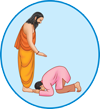


Does Hindu Dharma have the concept of eternal damnation (punishment in hell)?
The Dharmagranths say that those who knowingly choose evil, despite knowing what is right and wrong, must suffer the severest punishments in the hell realms.
The Dharmagranths say that those who knowingly choose evil, despite knowing what is right and wrong, must suffer the severest punishments in the hell realms.
Karma (An act or action which gives rise to destiny) that we do according to our intellect or will is called the kriyaman-karma. Of the total karmas that the human beings perform, 35% are done because of kriyaman-karma.
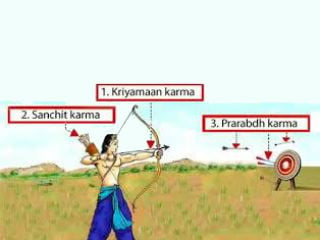
Since kriyaman-karma is associated with Dnyan-shakti (Energy of Knowledge), it is said that if it is done in an appropriate manner, one can overcome prarabdha-karma.

‘Prarabdha cannot be altered and one has to face the consequences’; but because of sadhana (Spiritual practice) performed with intense yearning, blessings of the Guru, grace of God etc., prarabdha becomes tolerable and can easily be overcome.
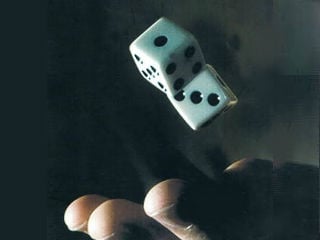
Prarabdha means our account of credit and debit (merits and demerits) of several earlier births, in God’s bank. We get what we hold in our account.
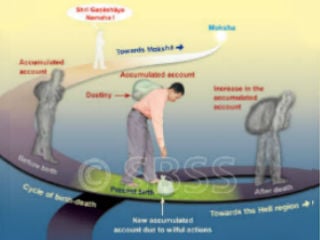
The bhog (sufferings) that are pending from the karmas of previous births are termed as sanchit-karma. The portion of sanchit-karma, because of which an individual has to undergo suffering in this birth, is called prarabdha-karma.

Karma (An act, action which gives rise to destiny) is the essence of human life. Knowing the importance and peculiarities of karma changes our attitude towards karma and we get exposed to a new dimension to perform it.
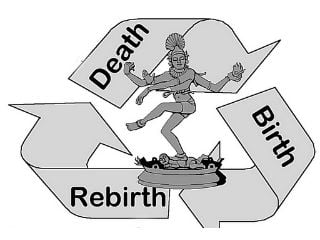
In life, karma (An act, action which gives rise to destiny) is unavoidable. Even to sustain life, the karma of breathing has to be performed. A continuous generation of ‘give-and-take’ accounts with others is a consequence that comes along with karma.
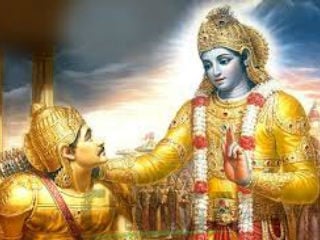
Mentioned ahead are the five factors operating towards the accomplishment of tasks. The venue of the karma (An act or action which gives rise to destiny) [that is the body], the doer, various senses, their different functions, and the presiding divinity.
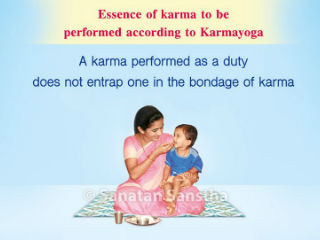
In life, karma (An act, action which gives rise to destiny) is unavoidable. A continuous generation of ‘give-and-take’ account with others is a consequence that comes along with karma.