

1. Advanced Indian farming traditions
Ancient Indian farming traditions were deeply in harmony with nature. This system was built on a strong foundation of using native seeds suited to local conditions, maintaining soil health, and preserving the biodiversity of soil bacteria, insects, and crops. Indian farmers weren’t just observers of the weather and seasons; they also understood how the movement of planets, stars, and specific lunar phases influenced crop growth. For example, since pests often lay eggs during the full moon and new moon, spraying natural pesticides on these days helps control them effectively.
2. Traditions preserved through proverbs and customs
Many aphorisms and proverbs are based on these traditions. Recently, I read an article by Mr. Baswant Vithabai Babarao, an environmental education researcher. He mentions a Marathi aphorism that roughly translates to planting the seed on Akshaya Tritiya leads to fruits by Bendur (celebrated around the full moon of the month of Ashadh). The soil is tilled and pits are prepared to sow seeds for summer crops on Akshay Tritiya. This day is considered the most auspicious time to begin farming tasks, especially for vegetables like bottle gourd, ridge gourd, pumpkin, ash gourd, bitter gourd, and various beans, as well as ginger and turmeric. By the festival of Bendur , these plants start bearing fruit.
3. Testing seed germination on Akshaya Tritiya
Mr. Babarao also describes a traditional method for testing seed quality. Testing seeds before large-scale sowing is very beneficial for farmers. To do this, take 100 seeds of the crop you intend to plant, arrange them in a row on a jute bag, roll it up, and soak it in water. Sprinkle a little water daily to keep it moist. Depending on the seed type, open the roll after 3 to 5 days and count the sprouted seeds. If more than 90 have germinated, the seeds are considered excellent for sowing. In some regions, this test is done by planting a small row of seeds directly in the ground.
4. Experiences with Terrace Gardening on Akshaya Tritiya
After reading about this, I decided to try planting summer vegetables on Akshaya Tritiya. I planted okra, bottle gourd, ash gourd, and ginger. True to the proverb, the okra and gourds were ready for harvest by the full moon of Ashadh. This is more than just a ritual; it is a time to test the germination of seeds.
A similar tradition is to start the winter growing season on the first day of Navaratri – Ghatasthapana. A variety of grains are sown in front of the Goddess during Navratri. The grains that sprout most vigorously are chosen for the main sowing. If you cannot start on the very first day, any time during the nine days of Navratri is considered ideal for planting.
Contents
- 1. Advanced Indian farming traditions
- 2. Traditions preserved through proverbs and customs
- 3. Testing seed germination on Akshaya Tritiya
- 4. Experiences with Terrace Gardening on Akshaya Tritiya
- 5. Winter vegetable varieties for your home
- 6. The October planting calendar
- 7. Pre-planting essentials: Bijamrut and Jeevamrut
- 8. Zero-budget gardening: Transforming household waste into wealth
- 9. A mission for toxin-free food
- 10. Invoking the Divine: The power of prayer in gardening
- 11. Cultivating resilience: The path to success

5. Winter vegetable varieties for your home
Winter is a bountiful season for terrace gardens and backyard gardens. The cooler temperatures provide the perfect environment for a wide variety of crops. Here is a breakdown of what you can easily cultivate:
- Leafy greens: Spinach (Palak), Fenugreek (Methi), Red Amaranth, Dill (Shepu), and Mustard (Sarso) thrive in the crisp winter air. These greens are not only easy to grow but are also nutrient-dense, making them essential for a healthy winter diet.
- Legumes: Winter is the ideal time for beans, peas, chickpeas (Harbhara), and pigeon peas (Toor). As dicotyledonous plants, they play a crucial role in ehancing soil health by naturally “fixing” nitrogen. These act as vital “companion crops”, nourishing the surrounding plants and eliminating the need for chemical fertilisers.
- Root vegetables: Now is the time to sow beetroot, radish, carrot, onion, and potato. Garlic is a particularly beginner-friendly option; simply tuck individual cloves into the soil at regular intervals, and they will flourish with minimal effort.
- Seedling-first crops: Certain vegetables like chillies, tomatoes, cabbage, cauliflower, broccoli, and Brussels sprouts require a two-stage process. You must first sow the seeds in small paper cups or nursery trays. Once the seedlings are robust, typically after 20–25 days or when they have developed 4 to 6 true leaves, transplant the strongest ones into your main pots or garden beds.
- The secret of marigolds: To ensure a truly thriving garden, always interplant marigolds with your vegetables. Their vibrant blooms act as a beacon for pollinators like bees, ensuring better yields. More importantly, marigolds secrete a natural substance from their roots that repels nematodes (microscopic root-knot worms) which commonly attack cabbage and eggplant.
6. The October planting calendar
As the monsoon recedes in October, the shift in humidity and temperature marks the perfect beginning for your winter garden. This month is all about timing and preparation. Focus your efforts on these two primary methods:
- Direct sowing: These crops prefer to grow exactly where they are planted and do not take well to being moved. You can sow the seeds of leafy greens, beetroot, carrots, potatoes, peas, and garlic directly into your main garden beds or large containers.
- Seedling preparation (the nursery phase): For crops with longer growing cycles, start your “nursery” now. Plant your chillies, tomatoes, and cauliflower seeds in small biodegradable cups or seed trays. By starting them now, they will develop the strength and root structure needed to be transplanted into their permanent “main beds” by late October.
7. Pre-planting essentials: Bijamrut and Jeevamrut
Success in natural gardening begins long before the first sprout appears. To ensure a resilient and high-yielding garden, you must focus on two foundational preparations:
- Seed treatment with Bijamrut: Before sowing, treat your seeds with Bijamrut. This ancient microbial coating acts as a natural shield, protecting seeds from soil-borne fungi and diseases while significantly improving germination rates. Think of it as an “immune booster” for your future plants.
- Soil nourishment with Jeevamrut: Once your plants are in the ground, sustain them with Jeevamrut, a potent, fermented microbial culture made from cow dung, urine, jaggery, and pulse flour. Rather than just feeding the plant, Jeevamrut feeds the soil itself, multiplying beneficial microbes and turning your garden into a “living, breathing ecosystem.”
Prepare Jeevamrut and Bijamrut at home
8. Zero-budget gardening: Transforming household waste into wealth
You don’t need a large budget or designer planters to start a successful garden. In natural farming, we believe in resourcefulness, using what is already available to create life.
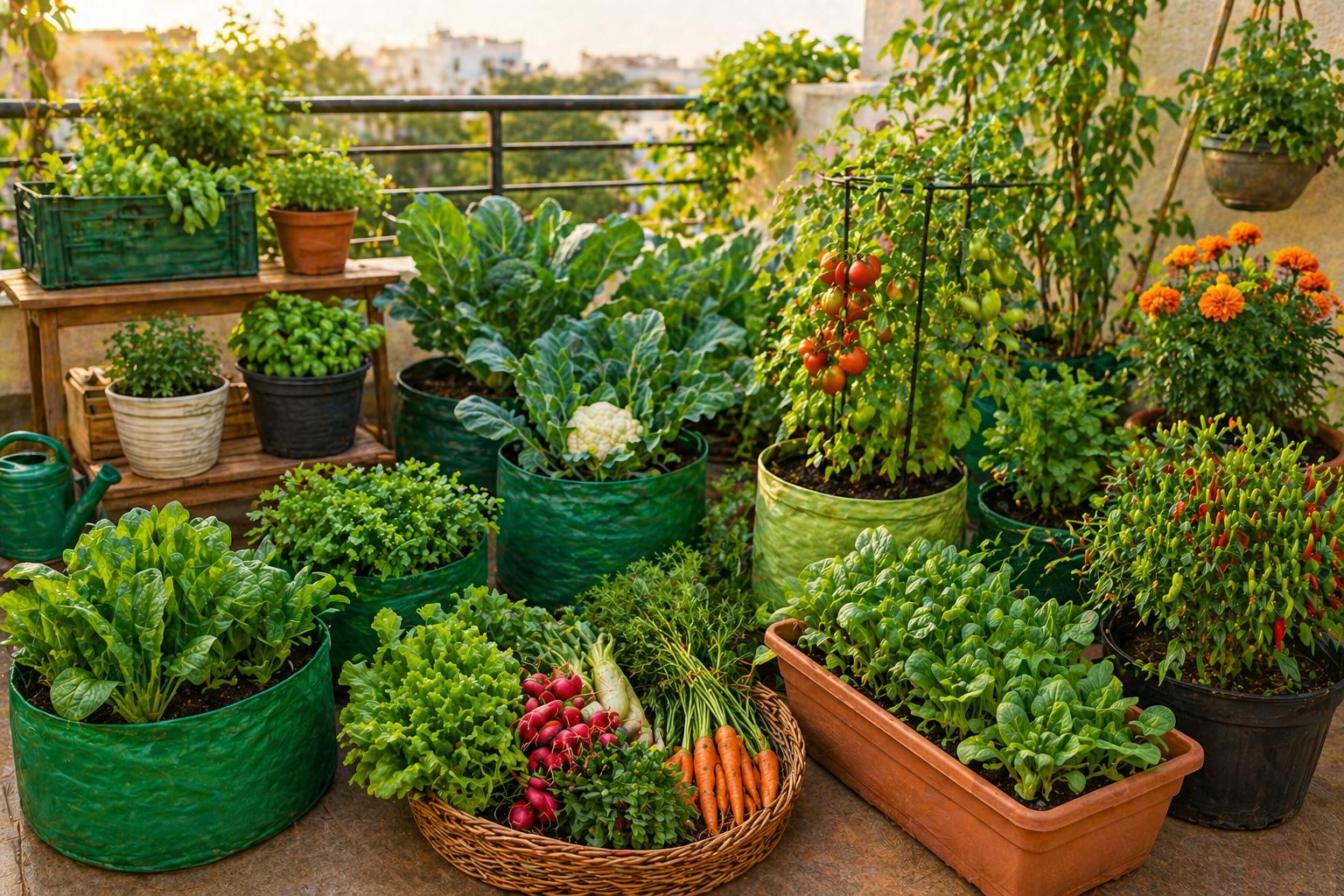
- Repurposed vessels: Before heading to the store, look around your home for containers that can be repurposed. Old oil tins, buckets, plastic tubs, grain sacks, and even discarded tyres make excellent planters. Just remember to poke a few drainage holes in the bottom to keep the roots healthy.
- The humus cycle: If you live in an urban area where soil is hard to find, you can manufacture your own high-quality Humus. Layer dry leaves, coconut husks, and wet kitchen waste (vegetable peels and fruit scraps) in a bin. In about two months, nature will transform this waste into rich, dark, fertile soil.
- The pantry nursery: Your kitchen is already stocked with high-quality seeds. Mustard (rai), fenugreek (methi), coriander (dhaniya), and chickpeas (chana) can be taken straight from your pantry and sown.
- Regenerative planting: Don’t throw away your kitchen scraps! The root-ends of a store-bought spinach bunch or mint stalks with a bit of root attached can be tucked into the soil to grow into entirely new plants.
9. A mission for toxin-free food
The reality of modern agriculture is alarming. Chemical pesticides are now so potent that farmers are forced to wear protective gear and cover their faces just to spray them. Ultimately, these “poisons” find their way onto our dinner plates, where health experts link them to the rising instances of diabetes, hypertension, and cancer.
By cultivating even a small portion of your own food using natural methods, you are doing more than just gardening, you are creating a sanctuary of health for your family. Every home-grown vegetable is a step toward a lifestyle free from industrial toxins.
10. Invoking the Divine: The power of prayer in gardening
In Indian traditions, planting is not merely a physical act, it is a spiritual communion with nature. To ensure your garden yields Sattvik and toxin-free produce, we begin with a prayer to invite the Divine Principle into our soil.
On the auspicious occasion of Ghatasthapana, as you sow your seeds, offer a sincere prayer to Mother Earth. This helps align your efforts with the energy of the Goddess, ensuring that your harvest is infused with purity and vitality.
Offer this prayer from the heart:
“O’ Mother Earth, O’ Dhanyalakshmi (Goddess of Food and Prosperity), please let your Divine Principle be present in this plantation. Teach us the nuances of this spiritual service and prepare us to be self-reliant and resilient in the times to come.”
By beginning with this invocation, you acknowledge that you are a co-creator with nature, turning your balcony or backyard into a sacred space of abundance.
11. Cultivating resilience: The path to success
If your first attempt at gardening doesn’t immediately result in a lush, bountiful harvest, do not be discouraged. Natural gardening is a profound science of observation. Instead of seeing a struggling plant as a failure, view it as a question from nature.
When troubleshooting your garden’s progress, consider these three pillars:
- Is the mulching adequate? Ensure the soil is well-covered. This “blanket” is essential to retain moisture and shield the delicate microbial life within.
- Is the Jeevamrut application consistent? To thrive, your soil requires a steady “pulse” of microbial energy. Ensure you are nourishing it regularly to maintain peak vitality.
- Is the hydration balanced? Aim for the “sponge effect”, soil that is consistently damp to the touch, never bone-dry yet never waterlogged.
Nature is a patient and rewarding mentor. With every seed you sow you are reclaiming your health, your environment, and your ultimate independence.
– Smt. Raghavi Mayuresh Konekar, Dhavali, Ponda, Goa.
 How to cultivate vital medicinal plants at home ? Part – 2
 How to cultivate vital medicinal plants at home ? Part – 1
 Natural farming: The sustainable alternative (Part 4)
 Natural farming: The sustainable alternative (Part 3)
 Natural farming: The sustainable alternative (Part 2)
 Natural farming: The sustainable alternative (Part 1)