

Contents
- 1. Initial experience with chemical farming at the Gurukul
- 2. The turning point: Recognising the toxicity of chemical farming
- 3. Transitioning to organic farming: The struggle with declining yields
- 4. Realising the limitations: The financial reality for the common farmer
- 5. A new path: Trialing natural farming under the guidance of Shri. Subhash Palekar
- 6. Achieving superior yields: The success of the natural farming transition
- 7. The crisis: Soil degradation leading to land abandonment
- 8. Diagnostic findings: Soil depletion and the loss of organic carbon
- 9. The underlying cause: How chemical farming destroys soil vitality
During a National Conference on Natural Farming in Gujarat in the year 2021, the Honourable Governor, Acharya Devvrat, gave an inspiring account of his journey with natural farming techniques. His firsthand experience offers a wealth of knowledge for those interested in sustainable agriculture. The following article highlights the key takeaways from his presentation.

1. Initial experience with chemical farming at the Gurukul
I am a teacher by profession, yet I have always considered myself a farmer. The principles I apply to my own land are relevant to every farmer across India. For 35 years, I served as the Principal of a Gurukul in Kurukshetra, Haryana, which provides residential education to 1,500 students. To ensure a steady supply of food for them, we cultivated grains on our 200-acre farm. I personally managed 90 acres to produce wheat, rice, pulses, and vegetables, while the remaining land was leased to other farmers.
2. The turning point: Recognising the toxicity of chemical farming
One day, a sobering incident occurred. I received word from the field that a worker had been spraying pesticides during the height of summer. The fumes were so potent that he collapsed, and it took him two to three days to recover in hospital. As all you farmers know, such incidents occur all too often. That day, a realisation struck me: I was spraying the very wheat, rice, pulses, and vegetables that I served to these children with these same toxic chemicals. If the mere fumes could render a grown man unconscious, what was I doing to these innocent children by feeding them produce laced with poison? I realised I was committing a grave injustice, and from that day on, I vowed to stop.
3. Transitioning to organic farming: The struggle with declining yields
I consulted with agricultural scientists and officials from the Agriculture Department, who suggested that I transition to organic farming. I immediately set to work, I prepared compost pits, applied manure, sourced earthworms, and implemented a systematic organic approach on five acres of land.
However, the initial results were discouraging. The first year, I received virtually no yield, as insects consumed the entire crop. I persisted into the second year, but managed only 50 per cent of the production I previously achieved with chemical methods. It was only by the third year, after relentless and painstaking effort, that I was able to reach about 80 per cent of my former output.
4. Realising the limitations: The financial reality for the common farmer
I began to reflect, I manage 200 acres of land, yet I struggled. If a small landholder with only two or three acres were to adopt this specific organic method, he would face nothing but financial ruin. How would his family survive?
This organic approach did not lower my costs, nor did it reduce my labour, yet, despite the extra effort, crop yields plummeted. It became clear that this was not a sustainable model for a typical farmer. I found myself at a crossroads, wondering if I should simply return to chemical farming.
5. A new path: Trialing natural farming under the guidance of Shri. Subhash Palekar
Around this time, I was introduced to Shri. Subhash Palekar, a pioneer in the field of ‘Natural Farming’. I invited him to our Gurukul to host a five-day workshop for 500 local farmers. I sat through the entire programme, immersing myself in the nuances of the technique, and was so impressed that I immediately trialled it on five acres of my farm.
6. Achieving superior yields: The success of the natural farming transition
The results were truly encouraging. In the very first year, the yield from my natural farming trials matched what I had previously achieved with chemical methods. Emboldened by this, I scaled up to 10 acres the next year with similar success. Eventually, I converted the entire 90 acres to natural farming, and the yields matched my previous chemical treated crop output. Today, my production exceeds what I ever achieved with chemical treated farming.
Read these articles (1 | 2 | 3 | 4) if you wish to implement the Natural Farming methods in your farm or kitchen garden.
7. The crisis: Soil degradation leading to land abandonment
In 2017, a further concern arose. For 35 years, I had leased 110 acres of the Gurukul’s land to local farmers. That year, they collectively decided to terminate their leases. Their reasoning was blunt: The soil is exhausted. It produces nothing, and we can no longer cover our costs; we simply cannot continue.
This was deeply alarming. I had entrusted them with highly fertile land three decades prior, and now, they were claiming it had become entirely unproductive.
8. Diagnostic findings: Soil depletion and the loss of organic carbon
I took this problem to Dr Hari Om, a senior agricultural scientist and head of the Krishi Vigyan Kendra at the Agricultural University in Hisar, Haryana. He advised me to have the soil tested professionally to determine its true condition. We collected hundreds of samples from across the fields and submitted them to the university for analysis.
The results were alarming: the organic carbon levels in the soil had plummeted to below 0.3 per cent. When I sought an explanation for this figure, Dr Hari Om was direct: ‘The farmers were right. Your land has become barren; it no longer retains the capacity to support crop growth.’
9. The underlying cause: How chemical farming destroys soil vitality
I appeal to farmers across India to consider why we have reached this crisis. The farmers who leased my land, in their pursuit of maximum yields, applied such vast quantities of urea, DAP, and pesticides that they effectively sterilised my fertile soil.
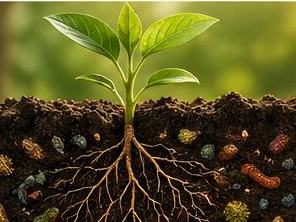
Unfortunately, this is the reality of soil health across the country. Synthetic inputs like urea, DAP, and pesticides are lethal to the very earthworms and microorganisms that create and maintain organic carbon. My land became barren because these essential, beneficial microorganisms had been completely wiped out by years of chemical exposure.”
 How to cultivate vital medicinal plants at home ? Part – 2
 How to cultivate vital medicinal plants at home ? Part – 1
 A seasonal guide to traditional home gardening
 Natural farming: The sustainable alternative (Part 4)
 Natural farming: The sustainable alternative (Part 3)
 Natural farming: The sustainable alternative (Part 2)