

To read Part 1 Click here – Collect and preserve the medicinal plants that grow naturally during monsoons ! (Part 1)
In this article let us understand information about the plants Silver cockscomb and Senna tora.
8. Few general tips that will be helpful while reading information about the plants
A. Latin name and the family to which a plant belongs are mentioned in the information given below. These are modern botanical terms which make it easy to find more information about any plant over the internet.
B. Initially, the uses of medicinal plants are given. General dosage of the herbal powder for adults is given in the points given thereafter. For the 3-to-7-year age group, the dosage should be 1/4th of the recommended dosage for adults and for the 8-to-14-year age group, the dosage should be ½ of the recommended dosage for adults.
C. Based on the usage of medicine, the quantity of fresh (not dried) medicinal plants to be collected for a family of 4 is mentioned. This is only a guideline, and everyone should collect the medicinal plants according to their needs.
D. Wherever the quantity of medicine has been provided in terms of the number of spoons, one should use a medium-sized spoon.
9. Medicinal plants that grow naturally during the monsoon season and later get dried up
9A. Silver cockscomb
9A 1. Alternate Marathi names : Kurdu, Haralu
9A 2. Sanskrut name : Shitivar
9A 3. Latin name : Celosia argentea
9A 4. Family : Amaranthaceae
9A 5. Use
A. Medicinal use
1. This plant is suitable for people with all types of constitution and does no harm.
2. It is highly effective medicine for kidney stones and urinary problems. Its seeds are more beneficial for kidney stones. 1 spoonful of seeds of the plant along with 1 spoonful of rock sugar should be consumed to alleviate kidney stone and to release the blocked urine.
3. This plant has cooling properties and can reduce heat in the body which could have increased due to any reason. It is highly effective in treating heat disorders such as heat generated in the body due to diseases like measles, chicken pox, herpes, heat caused by allopathic medicines, soar eyes, pimples on the face, pustules on the body, bloody haemorrhoids, excessive vaginal bleeding during menstruation or at other times, urinary burning and dizziness.
4. It has ability to increase haemoglobin and is a fatigue reliever. It has minerals such as iron, calcium, zinc, potassium etc. in abundant quantity. One should consume it as a vegetable during meals.
5. Panchang churna (Powder of the complete plant) should be consumed for the treatment of eye disorders, diarrhoea, white discharge from vaginal tract, skin disorders and for healing of boils.
6. Consume 1 spoon of seeds of the plant along with 2 spoons of ghee for sperm increase.
7. The roots of this plant are steeped in cold water and consumed as an antidote to hemp and marijuana.
8. The plant should be immersed in the water being heated for bathing. Once the water is hot, it should be filtered and then used for bathing by the individuals who have just recovered from an illness.
B. Usage in diet
1. Vegetable side dish prepared using its tender leaves is quite tasty and nutritious. In the times of emergency this plant can be used in the form of diet when there is a shortage of food items.
2. Edible oil can be extracted from its seeds.
9A 6. Signs of identification of the plant
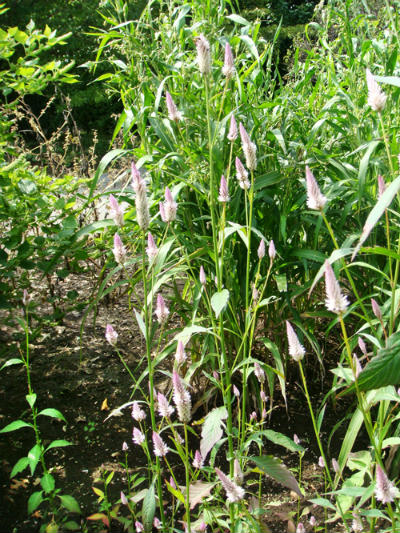
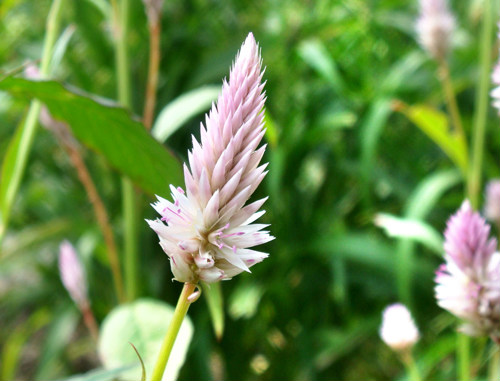
At the end of the rainy season, this plant is found in large numbers along roadsides, and on the meadows. The waist-high plant has white and pink cone shaped crowns or pods on the top. (See the picture above.) The crowns contain black coloured seeds which are smaller in size than the mustard seeds. This plant belongs to the family of Amaranth (leafy vegetable).
9A 7. Parts of the plant to be collected
A. Entire plant along with its roots should be collected, in the adequate quantity approximately weighing 5 kgs, powdered and stored.
B. Sack-full of pods of the plant should be collected. Before plucking the pods, one must crush a few samples to check and ensure that the seeds within them are fully ripened. Ripened seeds are black in colour. After removing the pods, they should be dried in the sun without being washed and crushed with hands or beaten up with a stick and the seeds should then be collected and stored. If necessary, the seeds can be washed and dried in the sun.
C. After extracting the seeds, the powder of the crushed residual pods should be kept separately. This powder can be added to the bathing water.
9A 8. Dosage
A. One spoonful of panchang powder should be dissolved in a bowl of water and should be consumed 2-3 times in the day.
B. 1 spoonful of seeds of the plant should be consumed along with a bowl of water.
C. Whenever possible, one should consume vegetable side dish prepared from the leaves of the plant.
9A 9. Cultivation
To ensure availability of this plant across all seasons, one can cultivate it in one’s backyard or in the terrace garden. Its seeds bear roots in 5 to 7 days after sowing. High quality leafy vegetables can be obtained in 30 to 40 days. In 80 to 90 days, the seeds become mature. If the tender leaves of the plant keep falling, it takes longer time to bear seeds. Sometimes if the plant is to be cultivated for the purpose of consumption as leafy vegetable, one can get good quality leaves, provided the fertilizers and water is given to the plants adequately. If the plant is cultivated in 10 square meters area, then at a time one can obtain 10 to 15 kgs of leafy vegetable.
9A 10. Who should avoid consuming this plant?
When the seeds of this plant are consumed, the pupils of the eyes get expanded to some extent. Therefore, people suffering from Glaucoma should not consume the seeds of this plant.
Reference : http://tropical.theferns.info/viewtropical.php?id=Celosia+argentea (16.11.2020)
9B. Senna tora
9B 1. Alternate Marathi names : Tarota, Takali, Taikila
9B 2. Sanskrut name : Chakramard, Edgaj
9B 3. Latin name : Senna tora, Senna obtusifolia
9B 4. Family : Fabaceae
9B 5. Use
A. Medicinal use
1. Its Sanskrut name is ‘चक्रमर्द’. ‘चक्र’ means ringworm. Since this plant eliminates (मर्द) ringworm, it is called as chakramard. In case of fungal infections like scabies and ringworm, if the juice of its leaves is applied 3-4 times in a day to the affected skin, the disease gets cured.
2. If the juice of Senna tora is massaged on the body (especially on the body-parts such as stomach, hips, breasts, throat) or if the panchang churna of this plant is rigorously massaged on the body, it helps reducing unnecessary fat accumulated in the body and the body becomes shapely. For additional benefit one should perform the Suryanamaskars daily.
3. Rubbing the mixture of Senna tora juice and gram flour on the skin makes it smooth and radiant. Unwanted oiliness, darkness and looseness in the skin gets reduced. If Senna tora juice is unavailable, one can use the mixture of the powder of the plant and gram flour.
4. Those who have a tendency of worm infestation, should consume 2 spoonsful of seeds of Senna tora by chewing them, take 2 spoons of castor oil after an hour and then drink half bowl of warm water. Worms in the stomach get flushed out with this remedy.
5. In case of bouts of cough, wheezing in the chest, shortness of breath, feeling of heaviness and dizziness, one should boil 2 teaspoons of powder of Senna tora seeds in 4 cups of water and extract 1 cup of decoction. While preparing the decoction one should add 2 leaves of Tulsi (Basil) and 2 crushed peppercorns. The hot decoction should be consumed sip by sip. With this the whitish phlegm gets expelled out.
6. In case of symptoms of occurrence of white spots on the body, swelling of the body, frequent colds or cough, one should consume vegetable dish made from the leaves of Senna tora along with bhakari (Indian bread) made from foodgrains.
7. Oil of Senna tora : 1 litre of Senna tora juice, 2 litres of cow urine, 25 grams of turmeric powder, 25 grams of liquorice root powder and 1 litre of sesame oil should be mixed and heated over slow flame to boil till only oil remains in it. Once the oil cools down, it should be poured into a bottle and 2 grams of fine powder of Ajwain flower should be added to it. Lid of the bottle should be tightly closed, and the bottle should be shaken so that the Ajwain flower gets dissolved in the oil. (Ajwain flower can be obtained from an Ayurvedic medicines store. If it is not available, Bhimseni camphor can be used in the same quantity). This oil should be used for external application.
A. This oil is extremely useful in all kinds of skin disorders, especially those in which there are symptoms of excessive itching, dampness.
B. In case of vaginal itching and sticky discharge from vagina, dip a cotton ball in this oil and place it inside the vagina track at night while sleeping.
C. This oil is incredibly beneficial in burns caused by fire, hot water, steam, electric shock etc. Do not let water to get in contact with the burnt area.
D. Applying this oil to the bruises (wounds) caused due to scratches, dents etc. is quite beneficial.
E. Massage with this oil to reduce fat.
Reference : Ahar Rahasya (Part 3 and 4), author : Vaidya Ramesh Madhusudan Nanal.
A. Dietary use
1. Powder of its roasted seeds can be used as a coffee substitute. It tastes exactly like coffee. This powder does not cause the side effects of coffee. This powder is effective in reducing cough and respiratory disorders. Therefore, instead of drinking tea or coffee, using the powder of Senna tora seeds is highly beneficial for our health.
2. Vegetable side dish prepared from its tender leaves is quite good. In the times of emergency, this can be used as an alternative diet in case of shortage of foodgrains.
9B 6. Signs of identification of the plant
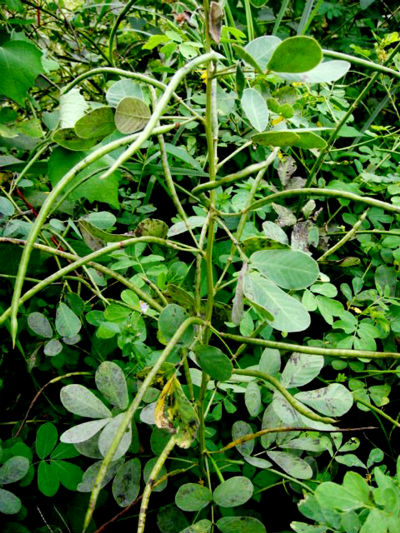
This plant is familiar to everyone. During the monsoons, these plants grow in large numbers along the road. Their tender leaves are consumed as vegetable. These plants grow up to waist height. They bear yellow-coloured flowers. These plants also bear beans which are semi-circular in shape. Post monsoon, these beans dry up and become brownish coloured. These beans have seeds which look like fenugreek seeds.
9B 7. Parts of the plant to be collected and medicines that get prepared
A. Entire plant along with its roots should be collected, in the adequate quantity approximately weighing 2 kgs, powdered and stored. This powder should be used for external application.
B. Dried beans from the plant should be gently cut using scissors and collected. If shaken, the seeds can spill out of the beans. About 2 to 4 kgs (or as per the quantity of tea or coffee powder one needs in a year) of beans should collected and dried well in the sun and the seeds should be separated from them. The shells of the beans should be discarded, and the seeds should be dried thoroughly in the sun. The dried seeds should be roasted in a pan on low flame, and then the seeds should be powdered after they cool down.
C. If oil is to be prepared, one must uproot complete plant and collect it in the quantity enough to extract adequate quantity of juice from it. During monsoon, when the leaves are fresh, the juice gets extracted from the plant in large quantity. As the plant dries up after the rainy season, one needs to add additional quantity of water and then extract juice from the plant.
9B 8. Dosage
1 to 2 spoons (as per the quantity required when preparing coffee) of powder of the seeds of the plant.
9B 9. Cultivation
There is no need to cultivate this plant. This plant grows abundantly during the rainy season in the natural environment; however, in certain countries this plant is cultivated for its seeds. For cultivation, one should keep the dried seeds of this plant immersed in a glassful of lukewarm water for 12 hours and then sow them. By doing this, the probability of the seeds taking root increases.
9B 10. Who should avoid consuming this plant?
A. Seeds of Senna tora should not be consumed in excess at one time. This can cause vomiting or diarrhoea.
B. In some places, oil is extracted from the seeds of Senna tora. However, this oil should not be used in the diet. It causes harm to the intestines and can lead to various disorders.
C. Ripe leaves of the plant are difficult to digest and therefore should not be consumed.’
 How to cultivate vital medicinal plants at home ? Part – 2
 How to cultivate vital medicinal plants at home ? Part – 1
 Uses of the rui (crown flower) plant in day-to-day living
 Sow medicinal herbs around your house to prepare for the coming adverse times