

There are innumerable plants with medicinal properties, so it is natural to wonder which ones should be cultivated at home. If we prioritise cultivating medicinal plants with a shorter cultivation span compared to the medicinal plants that mature as trees, they will be available sooner. This article provides information on how to cultivate some important medicinal plants which can utilised for medicinal purposes approximately 3 months after their planting. Saplings of medicinal plants are not easily available everywhere. Remedy to this is also given in this article. Readers are free to cultivate plants other than those mentioned in this article.
Contents
 |
||
| Shri. Madhav Paradkar | Vaidya Megharaj Paradkar | Dr Digambar Nabhu Mokaat |
1. Tulsi (Holy basil)
Importance
Tulsi decoction is beneficial for treating all kinds of fevers. Tulsi seeds have soothing effect and is an important medicine to overcome urinary disorders. Tulsi should be planted abundantly around one’s house, or along both sides of the path leading to the house. This keeps the environment pleasant. You can plant either black Tulsi (also called Krishna tulsi) or white Tulsi (Ram tulsi).
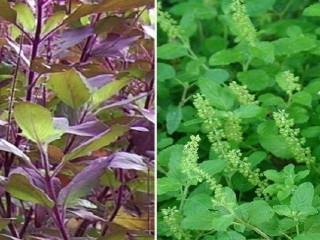
Growing Tulsi from seeds
When the dried blooms (flowers) of Tulsi are rubbed on the hands, its tiny seeds get expelled. Before sowing these seeds, they should be rubbed on hands. By doing this, the covering around these seeds gets ruptured to some extent and the chances of germination of such seeds increase. The thickness of the layer of soil above the seed should be equivalent to the thickness of the seed to be planted. Since the seeds of Tulsi are tiny one should only sprinkle small quantity of soil on it. If the tulsi seeds are sowed deep in the soil, then they do not germinate. Once the seeds are sowed, they should be watered very carefully, else the soil over seeds will drift away exposing the seeds. Once the sapling grows to about 4 to 6 inches in height, it should be carefully transplanted.
Remedies to prevent the infestation of ants
Tulsi seeds get immediately infested by ants. A deep dish (like the lid of a paint bucket) can be filled with water and the pot with the seeds should be placed in it. Ensure that water is always present around the pot, otherwise the ants may enter the pot and eat the seeds. You can sprinkle camphor powder around the pot to keep the ants away. Once the seeds germinate and saplings grow, the saplings can then be planted in the ground.
Cultivation from the saplings that grow in the rainy season
In the rainy season, saplings grow automatically due to the seeds that have already fallen from the Tulsi plant . These saplings also should be delicately uprooted and planted at proper places.
Caring for the saplings
Saplings of Tulsi should be watered regularly and the dried blooms should be trimmed.
2. Adulsa (Malabar nut or Justicia adhatoda or Adhatoda vasica)
Importance
Adulsa is called as ‘Bhishanmata (Mother of Ayurvedic doctors)’. Adulsa is used in treatment of various diseases and is extremely useful in treating infectious diseases. During the epidemic of Measles, Chicken pox and fever, consumption of Adulsa as well as adding it to the bath water is extremely beneficial. Vegetables and fruits last longer if they are kept in the leaves of Adulsa. Adulsa should be planted in as much quantity as possible around one’s house. Adulsa plants should be grown along the fencing of the premises.
Identification and places where Adulsa can be found
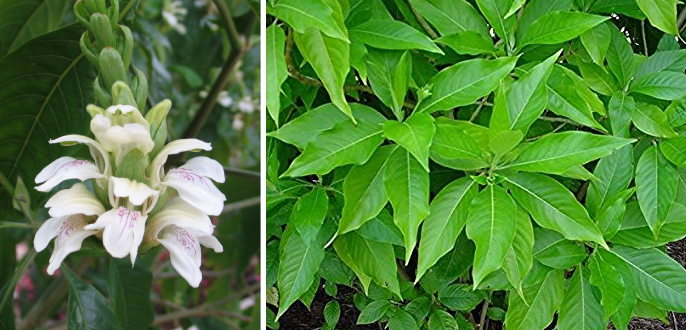
This plant is found in cities as well. At some places this plant can be found in large numbers. The leaves of this plant are lush green and have spear-like pointed edges. Ripened leaves are of yellow colour. The leaves have a peculiar scent.
Adulsa plant bear flowers from December to February. Its flowers are white coloured. The shape of the flower is akin to the open jaw of a lion. Therefore, one of its Sanskrit names is ‘Simhasya’ (lion’s mouth).
Cultivation using stems
The ripened grey-coloured stems of Adulsa should be cut for cultivation. The stems should be cut in the area just below a leaf node. Cut the leaves at the leaf node near the part of the stem which is to be sowed in the soil as its roots grow from that area. Evaporation of water takes place due to leaves with which the plant can prepare its food. If Adulsa is to be cultivated during summer, then to avoid evaporation of water from the stem in large quantities and to also enable the stem to prepare its food, the leaves in the upper region should be cut by half. There is no need to cut the leaves as mentioned above when cultivating the plant in the rainy season. After cultivating the stem of Adulsa, the roots generally develop in 15 days. Previous leaves fall off and the new ones grow.
3. Giloy
Importance
There is no limit to the qualities giloy possesses. Giloy’s importance became known to everyone during the covid pandemic. It is beneficial in many ailments from fever to Asthma. It is an excellent tonic. If it is mixed in the fodder of milch buffaloes and cows, then their milk production increases. Giloy should be cultivated in large quantities.
Identification
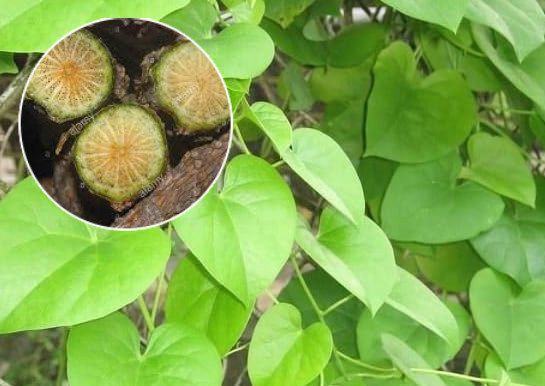
During the rainy season yellowish green coloured 2-3 mm thick twigs can be seen hanging from the roadside trees. These twigs are of giloy. Their outer skin is brownish grey coloured and it has blister like bumps on the outer skin. These twigs feature circular to rosette-like raised lenticels that appear as tiny white or creamy spots and vertical specks on the bark. When the outer bark is crushed, the outer brownish grey coloured skin gives apart and inner green coloured skin gets exposed. The core is yellow coloured. When cross-sectional cut is given to the lenticels of giloy with a sharp knife, inner shiny part can be seen. If a young twig is cut, it secretes a transparent water like juice. This juice is little bitter in taste.
Cultivation
If the lenticel of giloy is cut and kept on the ground and if it gets a nourishing environment, even then a creeper grows from it. Giloy vine also grows from the plant that is cut and thrown away. Therefore, it also bears the Sanskrit name ‘Chhinnaruha (‘Chhinna’ means after cutting and ‘ruha’ means getting created again)’. About 6 inch long cut stems of giloy should be planted vertically in the ground. While cutting the stem, the slanted cut should be made towards the root. If the slanted cut part is dipped into ‘Rootex’ powder available in the market and planted in the ground, then the roots grow quickly. (If any of the medicinal plants need to be grown from their stem and if their stems are dipped in Rootex powder as mentioned above, then their roots develop quickly and the possibility of the plants remaining live increases.) The creepers of the plant should be grown on the fence, grills of the balcony or on trees such as Mango, Neem etc.. The vine should not be grown on poisonous trees (e.g. Kajra or Kuchla [Strychnos nux-vomica]); because if it is grown on such trees then their poisonous attributes get acquired by the giloy creeper.
4. Aloe vera
Importance
Aloe vera is not a medicine that is needed regularly. But it is useful for treating burns and scalds, menstrual discomfort, coughs and phlegm. Two to four plants are sufficient for a family of 4; however, if there is space around the house, you can have 10 – 12 plants.
Cultivation
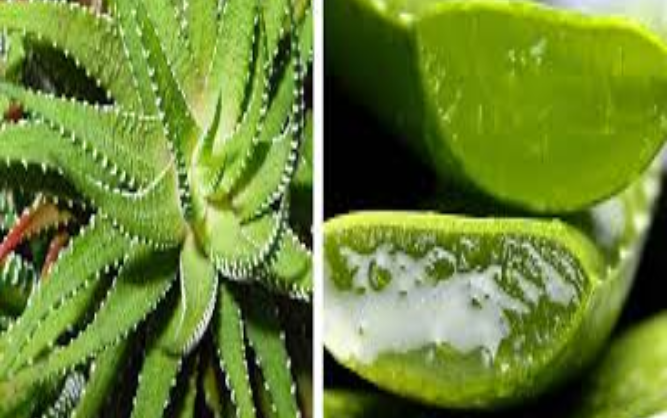
Aloe vera is planted in many households. It develops offsets or pups that grow at the base of the parent plant. These can be separated and replanted to produce new plants. If 1 – 2 pups are borrowed from the neighbours and planted, then within a year enough you can get enough quantity of Aloe vera that is sufficient for 4 people. Aloe vera saplings are also available for purchase in the nurseries.
5. Kalmegh (Andrographis paniculata)
Importance
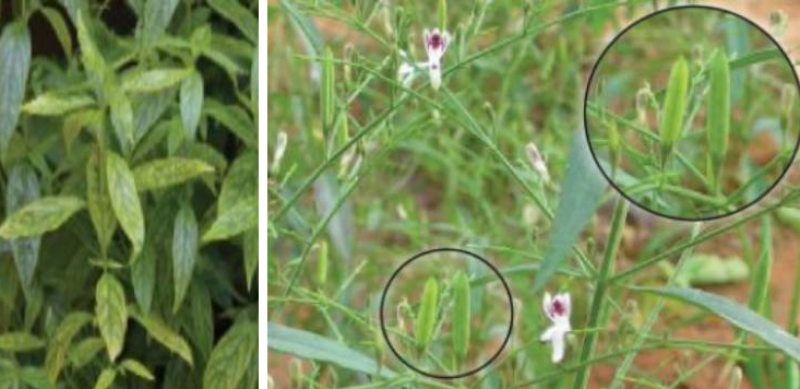
This medicinal plant is very useful in the treatment of infectious diseases. It is extremely bitter and used for curing fever and intestinal worms. Due to its laxative properties, it is customary at some places to prepare its kadha (Decoction) and consume it during the rainy and autumn seasons once a week. Since this plant tends to increase vata (Gases), its decoction should not be consumed every day in absence of fever and without consulting an Ayurvedic doctor.
Identification
This plant is called ‘Kirayate’ in Konkani language. The leaves of this plant are broad at the beginning of rainy season. After the rainy season its leaves become narrow. Only if it is watered after the rainy season, it survives, else it withers off. Most of the time, in Konkan region, this plant can be seen in dried condition after the rainy season at many places. At the end of the rainy season, it generates small pods. These pods contain its seeds.
Cultivation
Most of the households in Konkan region have this plant. After the first rain, saplings grow in large numbers from the seeds that have fallen before. These saplings can be planted. If the seeds that are generated at the end of the rainy season are gathered, then they can be sowed next year at the beginning of the rainfall to grow saplings.
6. Jasmine
Importance
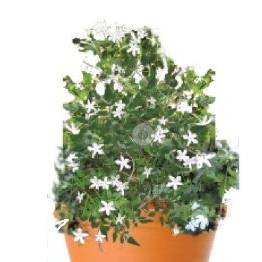
Jasmine leaves are used to stop bleeding. In case of mouth ulcers the leaves can be chewed and spit out to alleviate distress. One plant should suffice for the family of 4 members.
Cultivation
The branches of Jasmine can used for planting. If planting is done in rainy season, then to enable the roots to get enough warmth, one should wrap the part of the branch close to the roots with 1 – 2 twigs of dried grass. This enables the branch to get enough warmth for the roots to develop. If it is not wrapped with dried grass then the branch may decay or rot due to the cold.
Compiler: Shri. Madhav Ramchandra Paradkar and Vaidya Meghraj Madhav Paradkar.
Guide: Dr Digambar Nabhu Mokat, Professor, Department of Botanical Sciences, Savitribai Phule Pune University, Pune and Principle Director, Regional sub-facilitation Centre, Western Region (RCFC-WR), National Medicinal Plants Board (NMPB), Ministry of Ayush, Government of India.
 How to cultivate vital medicinal plants at home ? Part – 2
 Uses of the rui (crown flower) plant in day-to-day living
 Sow medicinal herbs around your house to prepare for the coming adverse times