

Hindu Dharma aligns the choice of clothing colours with the changing seasons, and by extension, the natural cosmic cycles governed by time, to ensure one derives the maximum spiritual benefit at every stage of the year.
śukla śāṃtyartha jāṇa । raktāsave vaśīkaraṇa । (शुक्ल शांत्यर्थ जाण । रक्तासवे वशीकरण )
abhicārī kṛṣṇavarṇa । pītavarṇa dhanāgamī ।। (अभिचारी कृष्णवर्ण । पीतवर्ण धनागमी ।।)
Meaning: Know that white is the symbol of peace. Red is used for vashikaran (attracting or influencing someone), while black is used for performing malevolent acts. Yellow indicates the arrival of wealth and prosperity.
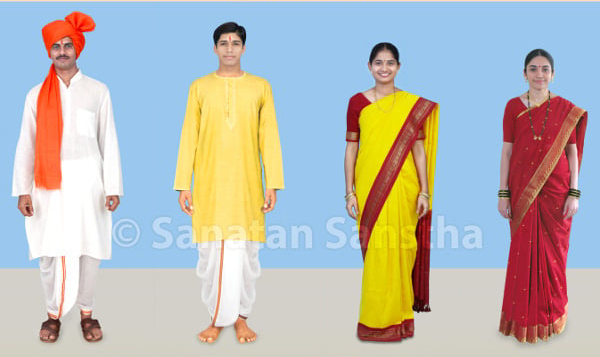
Colour of clothes according to the seasons
| Season | Colours of clothes |
| 1. Summer and Autumn | White. White clothes reflect the sun’s rays; hence, the body remains cool. |
| 2. Monsoons | White or yellow. |
| 3. Winter | Red, yellow, or black. |
| 4. Spring | Red or other dark colours. |
Seasonal Shades and Spiritual Science
1. Summer and Autumn
During this period, a higher volume of heat waves travels through the universe. This flow brings an influx of negative energies into the atmosphere.
To protect yourself, wear white clothing. White effectively combats these negative forces at the nirgun (unmanifest) level.
Because summer conditions welcome negative forces, they mostly exist in an unmanifest state. This unmanifest state is far more subtle and dangerous than a manifest one. Therefore, white clothes counter this hidden, imperceptible threat.
2. Monsoons
During the monsoon, flowing, manifest waves of the apatattva (Water element) dominate the universe. This environment draws in the principles of various lower and higher Deities. These Deities operate on the sagun-nirgun (manifest-unmanifest) plane.
Consequently, it is highly recommended to wear yellow and white. These colours naturally complement the active sagun-nirgun principles.
Choosing colours that suit these specific conditions helps you absorb the active energies of the Deities. This practice rapidly accelerates your spiritual growth.
3. Winter
Winter brings a greater flow of shakti (energy) waves through the atmosphere. These waves naturally tend to condense during this cold season. Red helps condense these shakti waves. Meanwhile, yellow converts shakti into Chaitanya (Divine consciousness). This transformation helps you gain spiritual benefits at a much higher level.
For this reason, yellow always accompanies red. The manifest chaitanya in yellow constantly drives and accelerates shakti-based activities at a subtle level. This explains why red and yellow form a natural pair. A prime example is the beneficial combination of haldi-kumkum (turmeric and vermilion) in ritual worship.
The festival of Makar Sankranti also takes place during this period. On this day, Raja-Sattva particles predominate in the atmosphere. Because of this protective environment, wearing black causes no spiritual distress. Black naturally helps condense the warm properties of the Tama-gun (attribute of darkness and inertia). Thus, black garments shield the body from the winter chill. Black serves a practical purpose at the gross, physical level. However, this colour can easily cause spiritual distress to an ordinary person. Relying on black purely to ward off the cold can be detrimental.
4. Spring
During Vasant ritu, the sagun (manifest) waves of the Deities reside heavily in the universe. To complement these waves, you should wear red. This colour mirrors the abundance of the manifest world and yields maximum spiritual benefits. Dark colours also help attract a Deity’s principle through shakti vibrations. However, they do so to a lesser degree at the sagun level. If red is unavailable, garments of other dark colours work well too.
Ultimately, Hindu Dharma harmonises clothing colours with seasonal cycles. This alignment with nature’s timing ensures you derive the highest spiritual benefit throughout the year.
– A Scholar (Through the medium of Shrichitshakti (Mrs) Anjali Gadgil (3.3.2008)
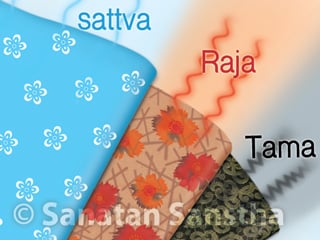 Colour psychology: Tuning your wardrobe to your true inner personality
 Comparison of different types of washed and unwashed, new and used clothes
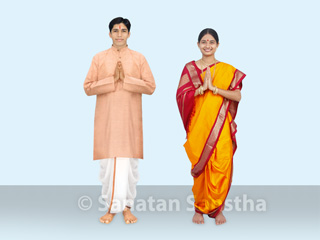 Effect of sattvik and inappropriate clothes on us
 Spiritual characteristics of various types of cloth