

Have you ever wondered why you instinctively reach for certain colours?
Your wardrobe says a lot about you. This guide reveals how to choose your clothes based on your personal preferences and physical constitution. You will also discover the fascinating spiritual science behind the colours you wear every day.
1. Constitution according to Ayurveda
Ayurveda links your physical constitution to specific fabric types and beneficial colours.
| Constitution | Fabric Type | Recommended Colour |
| 1. Vata | Cotton or kausheya (silk) | Red or yellow |
| 2. Pitta | Cotton | White, green, or blue |
| 3. Kapha | Wool | Red |
2. Constitution according to the trigunas
Your personal preferences naturally align with your inner constitution. This profile depends on three basic cosmic elements (trigunas): Sattva, Raja, and Tama.
| Dominant Guna | Key Characteristics and Traits | Colours Preferred by the Individual |
| 1. Sattva | Sociability, humility, and high concentration | White, yellow, and blue |
| 2. Raja | Courageous, proud, dynamic, and ambitious | Red and saffron-orange |
| 3. Tama | Short-tempered, narrow-minded, greedy, and lazy | Grey, ash-grey, dark red, purple, and black |
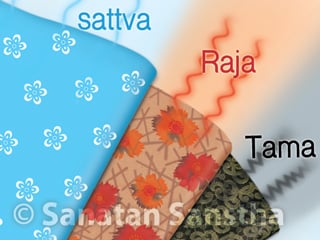
A. People naturally prefer the colour linked to the specific guna that influences them the most.
B. Developing sattvikta (spiritual purity) is vital in spirituality. As you make spiritual progress, your Sattva attribute naturally increases. Meanwhile, your Raja and Tama attributes steadily decrease.
C. A core spiritual principle focuses on “moving from many to one”. Spiritual growth always leads a person towards this divine oneness. For example, seekers progress from worshipping various Deities to focusing on a single Deity. The exact same logic applies to your clothes. A sattvik person chooses white or similar light shades. Conversely, a tama predominant person selects clothes featuring multiple contrasting colours or complex multi-coloured blends.
3. Clothing colours based on purpose
Your clothing choices can directly support the spiritual purpose of an activity. Here are two examples:
A. Cooking and Dining: Ancient wisdom states that eating food is a sacrificial act (yajnakarma), not just a way to fill your stomach. Because white symbols purity, women traditionally wore a pure white sari while cooking and serving food. Similarly, men wore clean washed white cotton or silk pancha (dhoti) and draped a second pancha over their upper body as an uttariya.
B. Funerals: Mourners wear white clothes during a funeral procession. This is because white naturally signals spiritual detachment (vairagya).
4. Colour preferences across three levels
Physical level
People generally dislike colours that clash with their skin tone. For example, bright red clothing can look overly loud on a dark-skinned person.
Mental level
Your colour preferences change temporarily based on your shifting emotions. Consider these everyday examples:
- People often wear vibrant, colourful clothes when going on a festive picnic.
- Pink is highly popular among youth. However, people lose interest in it as they grow older.
- The influence of a popular personality can quickly alter your taste. Young people routinely follow fashion trends by copying the colours that actors wear.
- Bitter political feelings can spark a deep dislike for certain colours. An Indian who resents Pakistan might dislike green, while groups who dislike Hindus might resent saffron.
Spiritual level
Your spiritual state directly guides your affinity for certain shades:
- You naturally select colours based on your dominant triguna constitution.
- Your taste in colour shifts according to your level of spiritual practice (sadhana). A seeker (sadhak) prefers blue when operating at the level of spiritual emotion (Bhav). They prefer yellow when reaching the level of divine consciousness (Chaitanya). Eventually, they prefer white upon reaching the level of deep peace (Shanti).
5. Spiritual principles for your wardrobe
To protect your spiritual energy, always aim for sattvik clothing. Select pure shades like white, yellow, blue, or their gentle variations.
A. Avoid gaudy colours
Bright, flashy colours reflect the heavy Tama attribute. Wearing gaudy clothes regularly will make a person tamasik over time.
B. Choose solid colours
A single, uniform colour represents greater spiritual transparency. Therefore, single-toned garments are spiritually much more sattvik.
C. Ensure colours complement
If you mix two colours, ensure they complement each other with at least a 20% match. Pairing two distinct sattvik colours is spiritually ideal. Excellent combinations include:
- White and light blue
- Dark blue and light blue
D. Avoid high contrast
Highly contrasting colour combinations generate negative vibrations. For example, never pair a sattvik yellow with a rajasik green. However, a light green shade that leans toward yellow works beautifully. Because it contains a high percentage of yellow, that specific shade remains highly sattvik.
6. Balancing energies in patterns
You can safely introduce small amounts of active colours if your base fabric is pure. For instance, a white garment featuring a delicate red floral pattern emits highly positive overall vibrations.
This happens because the dominant sattvik colour outweighs the rajasik red, keeping the restless rajasik effect to a absolute minimum. In short, the vibrations from your clothing depend entirely on the exact percentage of sattvik versus rajasik colours you use.
(Source: Seeker-artist Mrs Janhavi Shinde, Sanatan Ashram, Ramnathi, Goa)
Reference: Sanatan’s Holy text, ‘How should clothes be from a spiritual perspective?’
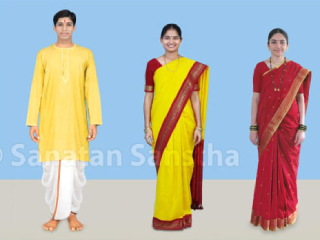 More than fashion: How seasonal clothing colours boost spiritual energy
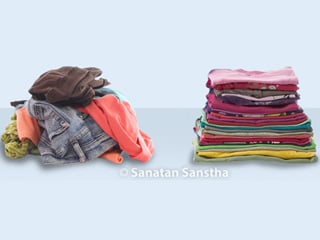 Comparison of different types of washed and unwashed, new and used clothes
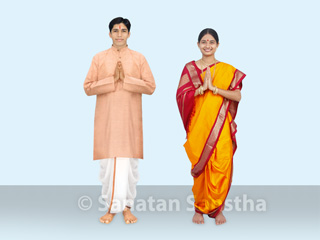 Effect of sattvik and inappropriate clothes on us
 Spiritual characteristics of various types of cloth
Namaste
Thank you for this article. You mentioned we should not wear contrasting colours but what if someone is dark skinned but still likes to wear light colours. Will it not create contrast?