
Contents
- 1. Sashtang namaskar – The best way to show respect
- 2. Namaskar with folded hands – the second best method of showing respect
- 3. How to offer obeisance to the Deity in a temple
- 4. How to show reverence to Saints
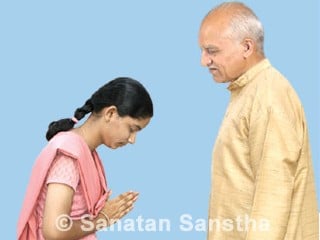
- 5. How to pay obeisance and seek blessings from elders
- 6. Spiritual benefits of a married couple offering obeisance together
- 7. Personal and spiritual benefits of paying obeisance the right way
- 8. Points to remember
- 8 A. Why should we close our eyes while paying obeisance ?
- 8 B. Can one pay obeisance with footwear on ?
- 8 C. Why should we not pay obeisance with one hand ?
- 8 D. Why is it advisable not to hold any object in the hands while paying obeisance ?
- 8 E. While paying obeisance, why are men not supposed to cover their head, whereas women are advised to cover their head ?
- 8 F. While performing religious acts, why should we avoid wrapping any cloth around our neck ?
- 8 G. Why should we pay obeisance when meeting someone by joining our hands instead of greeting with a handshake
A practice that is impressed upon us since childhood – showing reverence. Whether offering prayers with folded hands, performing a sashtang namaskar, or bowing before Saints and elders, each gesture carries deep meaning. Beyond tradition, these acts nurture devotion, humility, and increase positive energy. This article explores the correct ways to show respect (paying obeisance) in different scenarios and the deeper benefits of these gestures. Follow these ways of paying obeisance and benefit from the Chaitanya (Divine consciousness) !
1. Sashtang namaskar – The best way to show respect
उरसाशिरसादृष्ट्यामनसावचसातथा।
पद्भ्यांकराभ्यांजानुभ्यांप्रणामोऽष्टाङ्गउच्यते।।
urasāśirasādṛṣṭyāmanasāvacasātathā।
padbhyāṃkarābhyāṃjānubhyāṃpraṇāmo’ṣṭāṅgaucyate।।
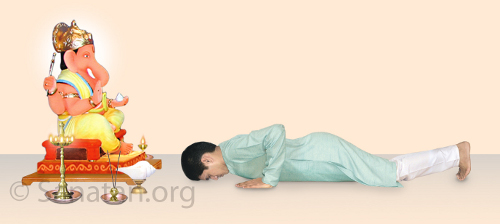
Meaning : Obeisance paid with 8 body parts such as 1. Chest, 2. Head, 3. Vision (paying obeisance by the means of our eyes), 4. Mind (paying obeisance by our mind), 5. Speech (uttering namaskar), 6. Legs, 7. Hands and 8. Knees, is called ‘sashtang namaskar’.
1 A. How to offer sashtang namaskar
1 A 1. First join your palms at the chest level, bend at the waist and place the palms flat on the floor.
1 A 2. Stretch your right leg back, followed by the left leg.
1 A 3. Lie down with your elbows folded and eyes shut so that the head, chest, hands, knees and toes are in contact with the floor.
1 A 4. Pay obeisance mentally to the Deity. Then say ‘namaskar’ out loud.
1 A 5. Stand up with the palms joined at the chest and pay obeisance with bhav.
So here you will invoke the Deity’s blessings by surrendering to the Deity in three ways – kaya, vacha, & manasa (physical, verbal and mental).
1 B. Do not rest completely on the floor while offering sashtang namaskar
When doing sashtang namaskar, people tend to raise both hands above the head and touch the floor with their complete arm from shoulders to the fingers. In this method our genitals come in contact with the floor. Scriptures say that it is inappropriate for the genitals to touch the floor. Therefore, sashtang namaskar done in this manner is inappropriate.
1 C. Spiritual meaning
‘Sashtang Namaskar is surrendering to God with one’s six foes (or defects of the embodied soul), mind and intellect. The six foes are associated with the subtle mind. The mind and the intellect referred to are the gross mind and gross intellect respectively.’ – Mrs. Anjali Gadgil, 8.7.2005, 1.34 pm.
(‘The six foes [namely lust, anger, greed, attachment, arrogance and jealousy] are the manifestation of the impressions created on the subconscious mind through various births. Impressions associated with subconscious mind, i.e. with inner mind, and inner mind is subtle with reference to the outer mind. Therefore, it has been mentioned above that the six foes are associated with subtle mind. What we generally call as thinking mind (outer mind) and the thinking intellect, are here referred to as gross mind and gross intellect respectively.’ – Compiler).
2. Namaskar with folded hands – the second best method of showing respect
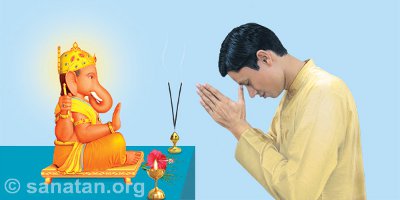
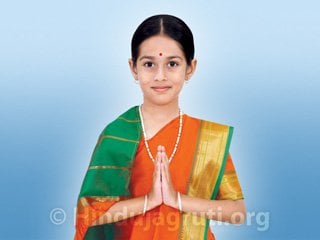
Whenever it is not possible to perform ‘sashtang namaskar’, one must pay obeisance with the hands joined. The act of paying obeisance must be performed slowly and with the specific steps involved in paying obeisance. These steps are elaborated below, also the act of paying obeisance by joining hands is depicted with the help of 2 pictures.
Video explaining how to pay obeisance :
2 A. Steps – while paying obeisance
2 A 1. While paying obeisance to God, to begin with, bring both the palms together and join them at the chest level.
- The fingers should be left loose while joining the palms.
- The fingers should be kept close to each other, without leaving any space between them.
- The fingers should be kept away from the thumbs.
- Seekers at the initial stage and the common people should keep their palms together while paying obeisance without keeping any gap between the palms. Seekers at the advanced stage who have been performing spiritual practice for past five to six years should keep a gap in their palms while offering obeisance.
2 A 2. After joining the hands, one should bow by bending at the waist.
2 A 3. At the same time, by bowing the head, one should place the thumbs in the mid-brow region, i.e., at the point between the eyebrows and try to concentrate at the feet of the Deity.

2 A 4. After that, instead of bringing the hands down immediately, hold them at chest level for a while in such a way that the thumbs of the joined hands are in contact with the center of the chest; then lower the hands.

3. How to offer obeisance to the Deity in a temple
3 A. Paying obeisance to the steps while entering a temple
3 A 1. Method : ‘One should touch the first step of the temple or sanctum sanctorum of a temple with both the hands and then move hands over one’s head. One should not pay obeisance to the step with just one hand.
3 A 2. Science underlying the act : Due to the movement of frequencies of Deities in the area around a temple, sattvikta is enhanced in the surroundings of a temple. The presence of Chaitanya in the area charges the steps of the temple too. Hence, there is a tradition of touching the step with both the hands and then moving the hands over one’s head.
From this we understand that since the dust accumulated on the steps of the temple is also charged with Chaitanya, we must respect it too and avail the benefit of Chaitanya in it as well. If the individual has a spiritual emotion that, ‘the Chaitanya of the Deity, with which the steps have been charged is spreading all over my body through the hands’, it gives increased benefit to the individual. Additionally, if the ego of the individual is low, then the benefit derived from paying obeisance is maximized. Any act which is performed with sacrifice of one’s ego becomes an akarma (An action which despite being a karma does not give rise to destiny).
3 A 3. What should be done if for some reason, one is unable to touch the steps with hands for paying obeisance ?
Due to old age or due to ill-health if one is unable to touch the steps of the temple with one’s hands for paying obeisance, then even by seeking forgiveness from God and ascending the steps with spiritual emotion towards God, one is able to derive the benefit of Chaitanya to the appropriate extent.’
– Mrs. Anjali Gadgil, 8.7.2005, 3.15 pm.
3 A 4. Why should we pay obeisance by standing next to the statue of Nandi in a Shiva temple and Tortoise in other temples ? : While paying obeisance in the Shiva temple by standing next to the Nandi and in other temples by standing next to the Tortoise, one does not suffer from the distress due to the sattvik waves emitted directly by the Deity’s idol and they can be imbibed as per the requirement of the individual.
3 A 5. Paying obeisance to a Deity : As far as possible men should pay obeisance to a Deity with sashtang namaskar, however, women should not pay obeisance with sashtang namaskar.
4. How to show reverence to Saints

4 A. Men should perform sashtang namaskar to Saints
As far as possible, men should perform sashtang namaskar to Saints. The procedure is similar to performing sashtang namaskar to Deities. Women should not perform sashtang namaskar.
4 B. Men and women should place their head on the feet of the Saints for paying obeisance
For some reason if it is not possible to perform sashtang namaskar, men should pay obeisance to the Saints in the following manner. Even women can follow the same for paying obeisance.
4 B 1. Part of the head to be placed on the feet : We can imbibe maximum Chaitanya through the Brahmarandhra. However, we cannot place Brahmarandhra on the Saint’s feet, therefore, the part of the head beginning above the forehead should be placedon the feet of the Saints. Due to this, the Chaitanya emanating from the Saint’s feet can enter to the maximum in the one paying obeisance.
4 B 2. Correct site for placing one’s head on the feet : The big toe of Saints emits maximum Chaitanya, hence, the head should be placed on the big toe instead of on centre of the foot. If both the feet are in front of you, then the head should be placed on the right big toe.
4 B 3. Position of hands while placing one’s head on the feet : While paying obeisance to a Saint, place both the palms on the Saint’s feet.
(‘Men and women should not touch celibates, renunciants and Saints busy in a religious ceremony, while paying obeisance’ – Compiler)
5. How to pay obeisance and seek blessings from elders
ऊर्ध्वंप्राणाह्युत्क्रामन्तियूनःस्थविरआयति।
प्रत्युत्थानाभिवादाभ्यांपुनस्तान्प्रतिपद्यते॥
– Manusmruti 2.120; Mahabharat, Udyog. 38.1, section 104, 64-65
Meaning : When an elderly individual arrives, the vital energy of the younger individual is pulled upwards. When this younger individual gets up and pays obeisance to the elderly individual, its vital energy comes back to the normal state.
5 A. Why should one pay obeisance to the elderly when they are about to leave for an outstation trip and after they return home from an outstation trip ?
Paying obeisance to the elderly at home signifies our surrender to the divinity present in them. When an individual bends to pay obeisance and submissively surrenders to the divinity in the elders, a sense of compassion is generated in his body. When this compassion permeates to his subtle body, its manah-shakti (Energy of the mind) gets activated, and it further activates the five vital energies located in the Manipur chakra. With the flow of the five vital energies in the body of the individual, its Atma-shakti (Energy of the soul) gets awakened. Due to the awakened Atma-shakti, the Sushumna-nadi of the individual gets activated and it transforms its expressed Bhavurja (Energy of spiritual emotion) into unexpressed Bhavurja. With the help of the unexpressed Bhavurja, the individual gets benefited from the required divine principles from the universe through the medium of the elders. For this reason, one should pay obeisance to the elders before leaving the home and obtain protection of the sattvik waves against the distressing frequencies from the environment. Similarly, after returning home as well one must immediately pay obeisance to the elders and awaken the divinity in them for elimination of Raja-Tama oriented environment around oneself.
– Mrs. Anjali Gadgil, 20.5.2005, 2.57 pm.
6. Spiritual benefits of a married couple offering obeisance together
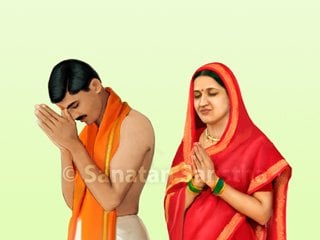
Marriage signifies blending of Principles of Deity Shiva in the form of husband and Shakti in the form of wife. Every act is taken to its completion jointly by performing that act through the sagun (Materialised) kriya-shakti (Energy of action) in the form of DeityShiva and giving further momentum to that act through the nirgun (Non-materialised) predominant Shakti. After marriage, both individuals enter the household stage. It is very important to obtain blessings of the elderly jointly to perform various activities in life in the householder stage by complementing each other. Paying obeisance together leads to activation of waves of Deity Shiva and Shakti from the universe. This enables development of humility in the individuals which in turn results in fulfilment of every deed in the householder stage and yields the desired fruit from it, leading to possibility of minimum give and take. That is why, after marriage, a couple is required to perform every act together and should comply with each other even in an act like paying obeisance. This is the aim underlying the act stated above.
If spiritual level of the couple or their spiritual emotion towards God is greater than 50%, the benefit obtained from paying obeisance together or individually or paying obeisance mentally is the same. Hence, as compared to the actual performance of the deed, one’s spiritual emotion towards God in performing the deed carries highest importance. (‘If only one of the husband and wife is present, then only one should offer obeisance.’ – Compiler)
6 A. When husband and wife are paying obeisance together, on which side of her husband should the wife stand ?
When paying obeisance together, the wife should stand to the right side of her husband. (Reference holy text – Sarth Shodashasanskar Ratnamala)
7. Personal and spiritual benefits of paying obeisance the right way
The main objective of paying obeisance to someone is to derive spiritual as well as worldly benefits from that person.
7 A. Worldly benefits
By paying obeisance to a Deity or a Saint, an ideal of their virtues and accomplishments comes to our mind unconsciously. Accordingly, we start emulating them, thus changing ourselves for better.
7 B. Spiritual benefits
7 B 1. Increase in humility and reduction of ego : While paying obeisance, when we think, ‘You are superior to me, I am the subordinate. I do not know anything, you are omniscient’, only then it helps in increasing our humility and reducing our ego.
7 B 2. Enhancement in the emotion of surrender and gratitude : While paying obeisance when thoughts in the mind are like, ‘I do not know anything, you alone get everything done, grant me a place at your Holy feet’, these thoughts help in increasing the spiritual emotion of surrender and gratitude.
7 B 3. Gaining sattvikta leading to faster spiritual progress :
- We imbibe greater amount of sattvikta from the posture of paying obeisance.
- By paying obeisance to Deities or Saints we receive subtle waves emitted by them, for example, waves of Sattva or Anand (Bliss).
- By paying obeisance to Deities or Saints we also receive their blessings. It helps in speedy spiritual progress.
– Miss. Madhura Bhikaji Bhosale, 2.12.2004, 7.15 pm.
8. Points to remember
8 A. Why should we close our eyes while paying obeisance ?
Joining hands with the head bowed means salutation to God or divinity in the other individual. The eyes should be closed while paying obeisance to God or any respected individual, to get the darshan of God within us.
– Miss. Madhura Bhosale, 2.12.2004, 7.28 pm.
8 B. Can one pay obeisance with footwear on ?
सोपानत्कश्चाशनासनशयनाभिवादननमस्कारन्वर्जयत्।
-Goutamsmruti 9
Meaning : While sitting, partaking of meals, sleeping, wishing and paying obeisance to Gurus and other senior individuals, one should not wear footwear.
8 C. Why should we not pay obeisance with one hand ?
जन्मप्रभृतियत्किञ्चित्सुकृतंसमुपार्जितम्।
तत्सर्वंनिष्फलंयातिएकहस्ताभिवादनात्।।
-Vyaghrapadsmruti 367
Meaning : Merits of a lifetime of an individual who pays obeisance with one hand are rendered fruitless.
8 D. Why is it advisable not to hold any object in the hands while paying obeisance ?
8 D 1. While paying obeisance when any object is held in the hands, usually the fingers and their tips are flexed and not straight. As a result, the sattvik (Sattva-predominant) waves which are received, are unable to enter the fingers or tips of the fingers due to the flexed position.
8 D 2. The sattvik waves emanating from the front of the seeker, strike the object held in his hands and are returned. Also, at times, instead of the individual absorbing them, the object may absorb the sattvik waves.
8 D 3. If the object held in the hands is Raja or Tama-predominant, and if it is touched to the forehead or chest when paying obeisance, then the Raja-Tama waves from it enter the body of the one who is paying obeisance.
– Mrs. Anjali Gadgil, 3.12.2004 1.32 pm
8 E. While paying obeisance, why are men not supposed to cover their head, whereas women are advised to cover their head ?
नसोपानद्वेष्टितशिराअवहितपाणिर्वाभिवादयीत।
-Aapastambha Dharmasutra 1/4/14/19
Meaning : We should not pay obeisance with footwear on, or with the head covered, or holding any object in the hand. (However, women should cover their head with their pallu (Free end of a sari) and only then pay obeisance.
8 F. While performing religious acts, why should we avoid wrapping any cloth around our neck ?
While performing circumambulation, ritualistic worship, sacrificial fires, chanting of God’s name and paying obeisance as well as taking darshan of Guru or Deity, one should not wrap any cloth around one’s neck. The reason behind this is that the cloth wrapped around one’s neck prevents one’s Vishuddha chakra from getting awakened. Therefore, the individual derives less benefit from the sattvikta.
8 G. Why should we pay obeisance when meeting someone by joining our hands instead of greeting with a handshake

8 G 1. While greeting with a handshake, germs can get transmitted to one another through the medium of the hand. Besides, some people do not have a habit of washing their hands after eating or after an outing. Under such circumstances, a handshake could be dangerous to health.
8 G 2. A handshake reduces humility and nourishes Tama temperament. When two individuals shake hands, the Raja-Tama vibrations emitting from their hands get accumulated in the void formed between the two palms. The energy generated in this void due to friction enters the bodies of the individuals through their palms. Aso, the subtle-particles radiated by this energy pollutes the environment surrounding the individual, making it Tama-predominant. The movement of these Raja-Tama particles in the body activates the Suryanadi and results in intense rise in the movement of Tama particles in the body. This affects the manomay-kosh, thus increasing the Tama particles in it and starts causing irritation to the individual.
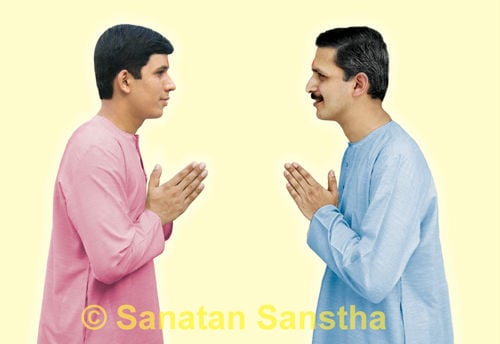
Hence, it is advisable to avoid such a Tama-predominant act of handshake and bring into practice the act of doing namaskar that increases sattvikta in the individual and teaches it to be humble. Hence, the individual gets Chaitanya based strength to perform various acts. Along with the blessings endowed with Sankalp-shakti (Energy of resolve), this act becomes sadhana and attains completion in lesser time.’
– Mrs. Anjali Gadgil, 28.5.2005
8 G 3. The act of handshake amounts to aping the western culture. By doing this, we promote the western culture and while doing namaskar, we promote Bharatiya culture. Bharatiyas themselves should promote Bharatiya culture and inculcate it in further generations too.
Reference : Sanatan’s Holy text, “The correct methods of paying Obeisance.”
To understand details of other religious acts, visit Religious acts and science behind them
 Praying with purpose – Expectations vs Surrender
 Deepajyoti Namostute !
 What should be done and what should be avoided while paying obeisance ?
 Methods of paying obeisance by husband and wife
 Paying obeisance – A simple act of expression of Divine qualities that bestows Divine Energy
 Waving a lit lamp symbolizes puja of Deity with Atmajyoti