
Nariyal Poornima (Pournima) is a festival celebrated during the change of seasons. During Nariyal Poornima (Pournima) the rainfall decreases. Hence, on this day people go to the coastlines and worship the sea, that is, Deity Varun. Deity Varun controls water / rain. Due to such worship Deity Varun is appeased and one does not have to face dangers of the sea. This festival is celebrated along the entire coastline of Bharat with great pomp and splendour.
On this day, the coconut to be offered to the sea is decorated. It is taken to the sea shore in a procession. Upon reaching the shore, the sea is worshiped and the coconut is offered with faith.
Importance of offering a coconut to the sea on the day of Nariyal Poornima (Pournima)
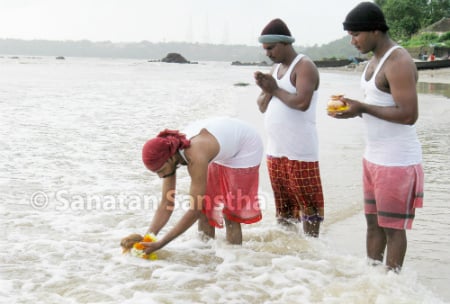
There is high proportion of Tejtattva (Absolute Fire Principle) in coconut water. Waves of Yama contain high proportion of Apatattva (Absolute Water Principle). On this day, there is predominance of Yama waves having high proportion of Apatattva in the universe. These waves move like a whirlpool in the universe. By invoking Deity Varun, the Yama waves are attracted towards the coconut water. The Tejtattva in coconut water controls these Yama waves. The Raja-Tama particles in these waves are disintegrated and are immersed in the sea. Due to this, the environment is also purified.
Subtle-effect of offering a coconut to the sea on Nariyal Poornima (Pournima)
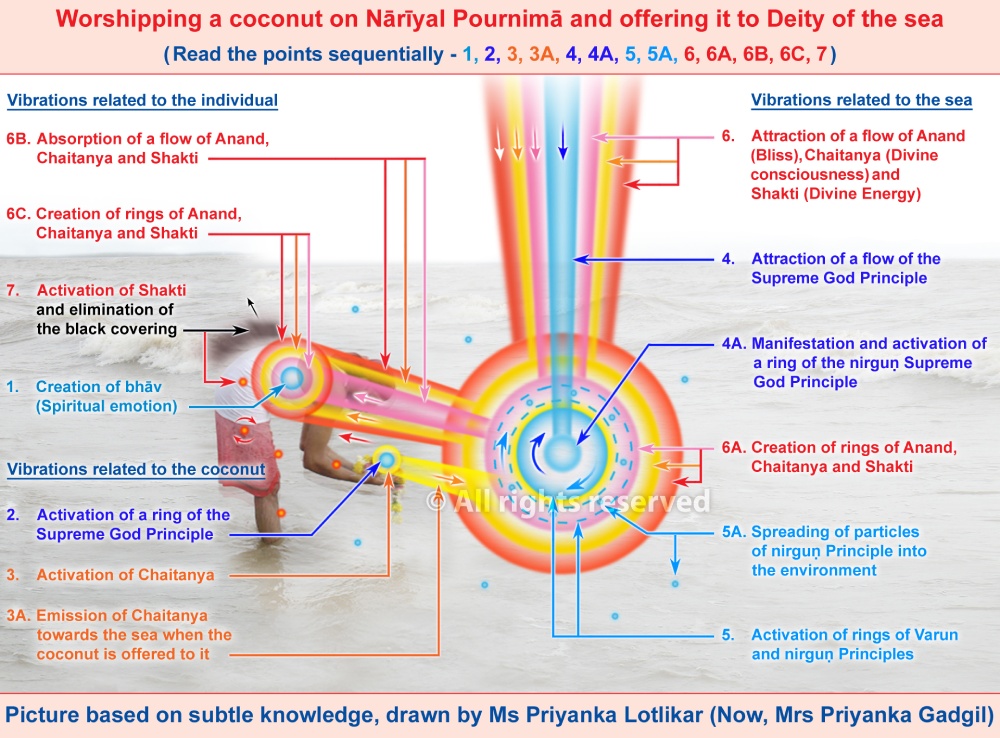
1. By paying obeisance to Deity Varun with bhav, a spiral of bhav is generated in the person.
2. By worshiping the coconut, a spiral of Divine Principle is activated in it.
3. A spiral of Chaitanya (Divine consciousness) is activated in the coconut. A flow of Chaitanya from God is attracted to the sea.
4. Due to Deity Varun’s worship with bhav, a flow of the Divine Principle is attracted to the sea. Unmanifest Divine Principle manifests in the form of a spiral and is activated.
5. The Principle of the Deity of rain (Deity Varun) is activated in the form of a spiral. The nirguntattva (Non-materialised Principle) is activated in a higher proportion in the sea in the form of a spiral. Particles of nirguntattva spread into the environment.
6. A flow of Anand (Bliss), Shakti (Divine Energy) and Chaitanya (Divine consciousness) is attracted from God. A spiral of the three is generated in the sea. A flow of the three is emitted towards the person. Rings of Anand, Shakti and Chaitanya are activated around the person too.
7. The black energy covering on the person is eliminated due to activation of Shakti.
Shravani
This Vedic ritual is performed on the day of Shravan Pournima, if there happens to be the lunar asterism Shravan on that day.
A. Importance: Shravani is a ritual performed when one resumes learning and teaching after a long vacation.
B. Method of performing the ritual: It is also referred to as Upkarma and Upkaran. If the Shravan lunar asterism appears on the Poornima (Pournima) of Shravan, then those following the Rigveda (Rugved) should perform this ritual on that day or on Nagpanchami day; if the Hasta lunar asterism appears, those following the Yajurved should perform it on the day of Shravan Poornima (Pournima), followers of the Samaved, in Bhadrapad on appearance of the Hasta lunar asterism and the Atharvaved followers on the Poornima (Pournima) day of the months of Shravan or Bhadrapad. Though this custom is very ancient and appropriate for the three classes, yet it is currently followed only by the Bhramins (Brahmans) and that too to a limited extent. Followers of the different Vedas (Veds) should celebrate Shravani according to their family norms. Usually this ritual is performed collectively.
 Raksha Bandhan (2026 Dates)
 Spiritual Significance of Raksha Bandhan