
Practical guidance for everyday life and future emergencies
According to Saints, seers, and astrologers, the upcoming period will be a terrible era of crisis, during which society will have to face numerous disasters. Protecting oneself and one’s family during a crisis is a major challenge. When transport links break down during a disaster, receiving timely help, taking a patient to the hospital, contacting a doctor or physician, and obtaining medicines in the market becomes extremely difficult. As part of the advance preparations to face the problems and illnesses that arise during a crisis, Sanatan Sanstha has a text titled ‘Practical Training in Firefighting’.
Preface
Although fire remains an essential component of daily life and commerce, the fine line between a controlled and an uncontrolled blaze is critical. Generally, humans control the fires they use, however, a fire can occasionally cross the line of control. When this happens, the people handling the fire must know what measures to take. While large factories, passenger ships, and aircraft regularly provide firefighting training, the general public and homemakers, who spend five to six hours a day cooking over open flames, unfortunately remain completely ignorant of fire science and firefighting measures. This ignorance causes numerous accidents. The main purpose of compiling this text is to provide scientific knowledge in simple language regarding fire science, various firefighting mediums, their methods of use, and the dangerous consequences of using the wrong mediums.
Disastrous fires cause large scale loss of both life and national wealth. Striving to prevent this loss allows citizens to participate directly in national interest and national protection.
Undergoing firefighting training is useful not only during a crisis but also for everyday life. This article introduces readers to firefighting training. The text discusses this topic in detail, and readers should certainly keep a copy of this book in their collection.
1. Components of fire
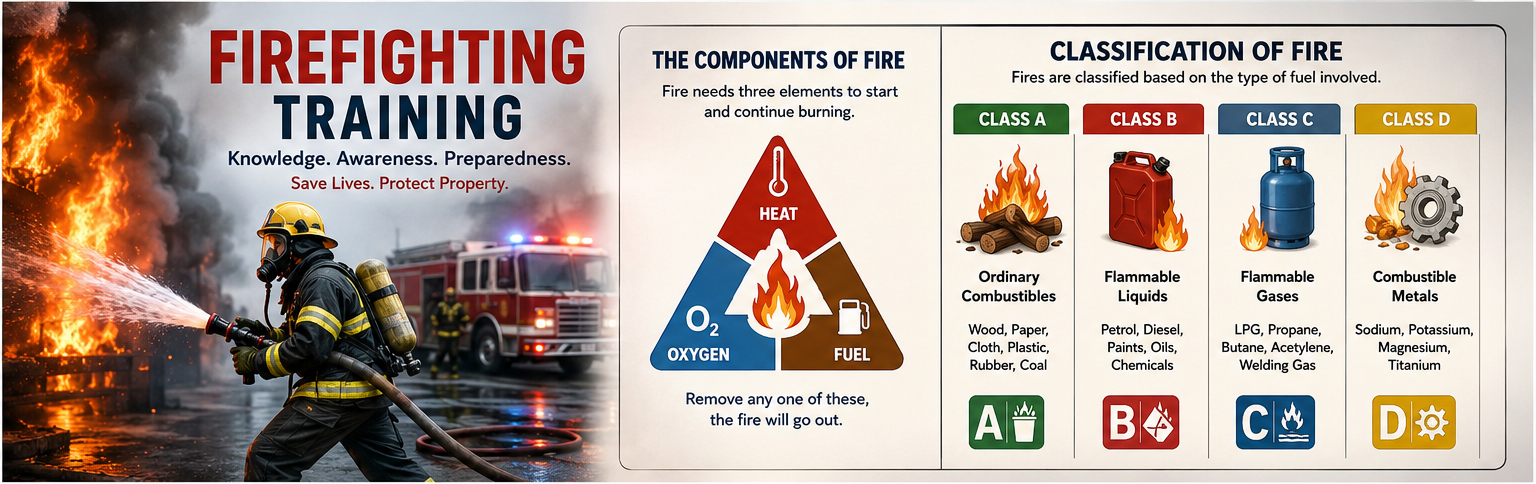
For a fire to form, three main components must come together: fuel (combustible material), oxygen, and heat. A fire develops only when all three components combine in the right proportions.
2. Common causes of fire
A. Natural
These fires stem from natural phenomena such as storms, earthquakes, and volcanic eruptions.
B. Unnatural
Humans bear direct or indirect responsibility for these fires. Unnatural fires stem from various sub-causes, such as ignorance, negligence (e.g., an iron overheating, or discarding a lit cigarette butt without extinguishing it), accidents, sabotage, war, etc.
3. Classification of fire
Planners classify fire into four types based on the type of fuel involved.
A. Class A fire
When the burning materials are carbonaceous and solid, such as paper, wood, coal, plastic, and rubber, experts term it a Class A fire.
B. Class B fire
When the burning material is a liquid, or when a solid substance melts into a burning liquid, it constitutes a Class B fire, e.g., petrol, diesel, lubricants, chemicals, paint, etc.
C. Class C fire
A fire involving a flammable gas, or one where the gaseous form of a liquid substance burns, is a Class C fire, e.g., cooking gas (LPG), welding gas, etc.
D. Class D fire
When any metal burns, it becomes a Class D fire, e.g., sodium, potassium, magnesium, titanium, etc.
4. What will you do on seeing a fire?
- Alert the people around you by shouting “Fire! Fire!” loudly.
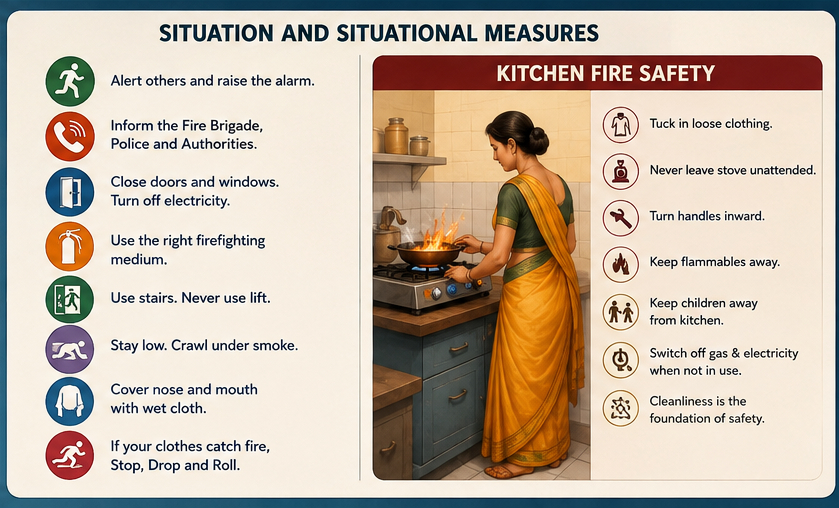
- Inform the fire brigade, police, and municipal corporation about the incident immediately.
- Try to keep the fire contained until the fire brigade arrives. Close doors and windows. Turn off the electricity supply. Move surrounding flammable materials to a safe place. If possible, wet the area around the fire using a water spray.
- Extinguish the fire using the appropriate type of firefighting medium.
5. Methods of firefighting
A. Depriving of fuel (starving)
If you deprive the fire of fuel or stop the fuel supply, the fire extinguishes immediately. Experts call this method starving. For example, when turning off a gas stove, you stop the gas supply. The stove goes out because it receives no fuel.
B. Cooling
If you bring the temperature of the burning material below its ignition point, that means, if you reduce the heat within the substance, the fire extinguishes immediately. Firefighters call this method cooling, e.g., pouring water on burning wood.
C. Cutting off gas/air (smothering)
If you completely cut off the oxygen supply to the fire, or if the proportion of oxygen in the air drops below 16 per cent, the fire goes out immediately. The classic experiment of covering a burning candle with a glass proves this rule. Firefighters know this as cutting off the air (smothering).
D. Breaking the chain reaction
By using certain chemicals, you can break the chemical chain reaction of combustion to extinguish the fire, e.g., halon gas. Since these chemicals are highly expensive, teams limit their use to specific scenarios.
6. Firefighting mediums
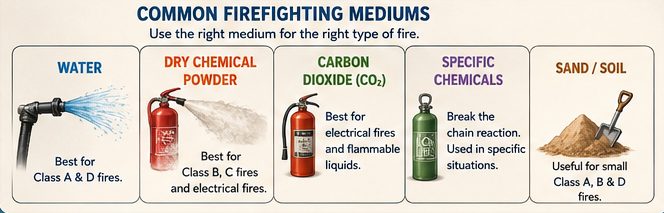
The commonly used firefighting mediums and their working methods include:
A. Water
Continuously spraying water on carbonaceous materials like burning wood and paper (Class A fire) or on metal (Class D fire) allows the water to absorb heat from the burning substances. The fire goes out if the speed of heat absorption exceeds the speed of heat generation.
B. Dry chemical powder
Chemical powders like sodium bicarbonate and potassium bicarbonate function as dry powders. They appear pure white. Pressurised liquid carbon dioxide gas sprays this powder over the fire, creating a dense cloud of powder particles over the flames. This cloud cuts off the fire’s contact with the air. The fire goes out because it lacks oxygen and the combustion chain reaction breaks. People primarily use this medium to extinguish Class B and Class C fires. Dry powder also yields excellent results when electrical equipment burns.
C. Carbon dioxide
A special cylinder stores this gas in liquid form under extremely high pressure. When you spray this gas onto a fire, it forms a heavy layer over the burning substance because it weighs five times more than air. This action cuts off the fire’s contact with the air and oxygen, extinguishing the flames. People mainly use carbon dioxide when electrical equipment catches fire.
D. Specific chemicals
Certain chemicals help extinguish fires by breaking the combustion chain reaction. Firefighters make limited use of these specialist chemicals.
E. Sand
If the fire is small and no other medium is available, sand effectively extinguishes Class A, B, and D fires. If you cannot find sand, loose soil works as well.
7. Situation and situational measures
While swift action is vital for firefighting, the decision of whether to fight the fire alone is equally or even more important. A few guidelines make this decision easier. Do not attempt to fight the fire if you answer “yes” to any of the following questions, as doing so could cost you your life:
- Is the fire spreading rapidly from its point of origin?
- Is it impossible to extinguish the fire without turning your back on your escape route?
- Is the fire blocking your only escape route?
- Do you lack the proper firefighting equipment?
- Have you run out of firefighting medium?
- Do you lack personal protective equipment against fire?
In these situations, do not attempt to extinguish the fire; immediately evacuate the location to a safe place and call for help.
A. Escaping a burning house/building
When leaving a burning room or floor, the last person out should simply pull the door shut behind them without locking it. Locking the door hinders the fire brigade’s search and rescue efforts.
- Exit strictly through the routes specified in the emergency action plan.
- Never use the lift during an emergency under any circumstances.
- Crouch low to avoid smoke and toxic gases, as clean air stays close to the ground. If necessary, lie face down on the ground and crawl forward on your hands and knees. Do not slither on your stomach. Heat causes smoke to rise, and certain heavy toxic gases form a layer on the floor; therefore, you should hold your head about 0.5 metres above the ground while crawling.
- If possible, cover your nose and mouth with a wet cloth.
- When moving through a burning staircase or room, walk strictly along the wall. Since builders erect walls over the main structural framework of the building, the area near the wall remains the safest, whereas other sections are likely to collapse.
- In a multi-storey building, the stairs serve as the primary escape route. Exit calmly, carefully, and in an orderly manner.
- Once on the stairs, descend on one side only. Leave the other side of the staircase clear for the firefighting and rescue teams. Never go back up.
- Once outside the building, immediately inform the fire brigade and police force about the incident.
B. If your clothes catch fire
Stop where you are, drop to the ground, and roll. Ensure the burning side of your clothes stays against the ground, as this smothers the flames and saves your life. Do not run in panic if your clothes catch fire, as running fans the flames, and do not roll violently on the ground.
C. If a companion’s clothes catch fire
Take a rug, blanket, mat, or any thick cloth and wrap it tightly around the burning person.
- Once you extinguish the fire, remove the burnt clothes from their body.
- Provide appropriate first aid immediately.
8. Fire prevention measures
The following guidelines outline general safety measures to take during specific daily life situations.
A. Fires caused by electricity and electrical appliances
- Turn off the switch of electrical appliances and pull out the plug after finishing work.
- If you open electrical appliances for repair, ensure the wire connections are tight. Have a skilled technician carry out the repairs.
- Keep electrical appliances, especially their motors, clean. Do not allow dust, oil, or grease to accumulate on them.
- Since electrical hand lamps used in factories have long wires attached, workers can move them wherever needed. Hand lamps must have a glass cover, as the heat from the lamp can ignite oily substances.
- Do not keep or store flammable substances near electrical appliances or switches.
- If a fuse wire burns out, use a wire of the correct capacity only.
- If an electrical appliance emits a burnt or unusual smell, switch it off immediately and inspect it. A burnt smell is a primary sign of fire.
- Do not overload any appliance or electrical switch beyond its capacity.
- Do not run electrical wires through water or hot areas. Do not run them across the floor, under carpets, or through doors and windows.
- Do not touch electrical appliances with wet hands.
- Do not leave electrical wire joints exposed. Cover them with appropriate insulating tape.
B. Kitchen fires
- Arrange the kitchen layout properly to ensure maximum safety.
- Do not wear loose, flowing clothes while cooking; tuck the pleats and end of your saree securely.
- Always use tongs or a pair of pincers when removing hot utensils from the stove. Using towels, cloths, or the end of a saree for this task is extremely dangerous.
- Never leave the house while a domestic gas stove, traditional stove, or oven is running.
- Extinguish all candles and oil lamps when no one is at home or before going to sleep.
- Always keep a domestic gas stove or traditional stove on an elevated surface; never place it directly on the floor.
- When placing a pot with a handle on the stove, keep the handle turned inward.
- Keep flammable items like wooden cabinets, shelves, curtains, and clothes far away from the stove.
- Do not allow young children to play in the kitchen.
- Take extra care when using a microwave oven. Even if it feels cool on the outside, the temperature of the food inside can remain dangerously high. If an item in the oven catches fire, switch off the power supply immediately and do not open the oven door until the fire goes out completely.
- Hold matchsticks away from your body when lighting them. Ensure you completely extinguish the lit matchstick before throwing it away.
- Cleanliness forms the absolute foundation of effective fire prevention.
(For detailed instructions, read Sanatan’s text: Practical Training in Firefighting)
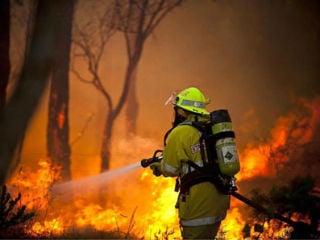 Practical training in firefighting
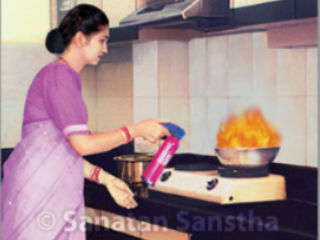 Techniques of firefighting
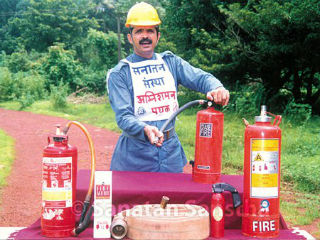 Situations and remedial measures in firefighting