

Sachchidananda Parabrahman (Dr) Athavale
Introducing the world to the happenings of the subtle dimension and conducting spiritual research into it
In various articles on the website, you will see that subtle-pictures have been used in different places to explain the science of underlyin a particular act/action. Let us understand what the ‘subtle dimension’ is as well as the meanings of various terms related to it.
The journey of Sachchidananda Parabrahman (Dr) Athavale’s research work from ‘the subtle to the gross’
Generally, the direction of research is from ‘the known to the unknown’, meaning from ‘the gross to the subtle’. In Sachchidananda Parabrahman (Dr) Athavale’s (Gurudev) case however, the journey has been in the opposite direction compared to conventional researchers – first research in the subtle and then in the gross. Around 1982, Gurudev began perceiving the subtle dimension. In the initial stages, He would get answers in the form of a ‘yes’ or a ‘no’. Then around 1987 He started obtaining answers in more detail. To verify the truth of these answers, He conducted various experiments, e.g., viewing through meditation what writing is on which page of an unread book, describing it, and then looking at ‘what is actually on that page of the book’; visiting someone’s house in a meditative state, describing the house, and asking that person about the truth of the description, etc. When the accuracy of answers in many such experiments began to exceed 95 percent, Gurudev realized that ‘the answers He was receiving through meditation were true’. After that, He began to perceive through the subtle the comparative importance of various causes behind a problem in percentages (e.g., to what extent physical, mental, and spiritual causes are present among the fundamental reasons behind someone not getting married), providing remedies for problems, etc.
Paratpar Guru Doctor studying vibrations by placing his hand on an envelope (Year 1999)
Obtaining knowledge from the subtle is an invaluable achievement from the perspective of the welfare of mankind; because there are limitations to obtaining answers through intellect and experience, but perceiving from the subtle is limitless.
Unique research regarding developing the method of perceiving from the subtle
After achieving the ability to perceive in the subtle and obtain knowledge from the subtle himself, Gurudev did not stop there. He consistently made research oriented efforts on how this ability to perceive from the subtle (meaning beyond the five senses, mind, and intellect) could be developed in other seekers. Under this revolutionary research which began in the year 2006, He initially had seekers – who could understand a little bit of the subtle – repeatedly conduct subtle dimension readings. Through that, the seekers’ capacity to perceive from the subtle became awakened and functional. Over time, it became clear that ‘among the seekers who understand from the subtle, some seekers receive this knowledge, which is beyond the comprehension of the intellect, through words, while some seekers receive it in the form of pictures’. Not resting content even with this, he continued the research in this regard uninterruptedly.
Creation of pictures based on subtle knowledge
Some seekers began to show the knowledge they received in a visible form through pictures. These pictures were given the term ‘picture based on subtle knowledge’. The subtle-pictures drawn by seekers so far are of many types, such as good or bad energies in the subtle, the aura of a Deity, or the subtle vibrations of living or non-living objects, as well as the effect of an event (e.g., the effect on a person – of a religious ritual or dancing-singing at midnight).
A. Analytical categorisation of subtle pictures
The categorisation of types of these pictures is Gurudev’s invaluable gift to the world of subtle pictures. Initially, all pictures had a single group called ‘subtle pictures’. After that, they were classified into ‘correct’ and ‘incorrect’. Even after that, combining the 4 types of artwork at the mental level—illusory (bhasmaan), imaginary (kalpanik), magical (mayavi), and emotional (bhavnatmak)—and the 5th type based on subtle sight, ‘true’ (satya), all pictures could be classified accordingly.
B. Standardisation of vibrations and colours in the subtle
Research regarding ‘the standardisation of vibrations and colours of subtle pictures’ is a major contribution by Gurudev in the research of subtle pictures. Positive and negative subtle energy is emitted in the form of rings, flows, particles, vibrations, and rays. Each form has a specific function and property. Colours in the subtle are not visible to the eyes, they can only be seen with subtle vision. They are transparent and self-illuminated. Therefore, they do not cast a shadow. Gross colours mix into each other to create a third colour; however, subtle colours do not mix into each other — these unique discoveries were made by Gurudev.
C. Verification of the accuracy of subtle-pictures
The mind and intellect of Saints or Gurus who have a spiritual level of 90 percent or more are unified with the Universal Mind and Universal Intellect respectively. Therefore, they can obtain any answer from the Universal Mind and Universal Intellect or can understand from the subtle. Gurudev Himself verifies the accuracy of every picture of all the seekers who draw subtle pictures. He states exactly how much the truth of the subtle picture is in percentage, and also points out the inaccurate part and gets it corrected.
Developing the capacity in seekers to obtain subtle knowledge by going beyond space and time
Initially, the subtle artists used to get knowledge from the subtle regarding an object or person when they were right in front of them; but the accuracy of the subtle reading done when the object was not in front of them used to be low. Over time, due to the increase in the spiritual practice of the seekers who receive subtle knowledge, as well as due to the blessings of Gurudev, they can now obtain knowledge even by going beyond space, e.g., knowledge about an unknown person anywhere in the world can be obtained merely by looking at their photograph or video clip, or even when no medium is in front of them.
If a subtle reading of an event is done some time after it has passed, its accuracy is low; because with time, the vibrations of that event in the atmosphere begin to decrease. Due to the blessings of Gurudev, the subtle artists can now obtain true knowledge not only about events in the near past or future, but also about events in a person’s past life.
From the above nuances regarding the research of subtle-pictures, the scope and depth of that research becomes apparent.
Importance of pictures based on subtle knowledge
Out of the total creation, the visible world is only 1 percent, while the world in the subtle is 99 percent. Therefore, this subtle world also affects humans to that same large extent; but because that world is subtle, it or its effect is beyond our understanding. Pictures based on subtle knowledge contribute to providing information about the subtle world in the following ways.
A. Subtle pictures help us to understand the happenings in the subtle in a visible form.
B. These pictures can be used to diagnose the spiritual state of a person.
C. Subtle pictures provide objective information about whether the subtle vibrations regarding an object or a person are spiritually positive or negative. From this, a decision can be made on whether to avoid that object, person, or event.
D. Humans have curiosity about the subtle world. Subtle-pictures resolve this curiosity of theirs to some extent. While doing this, one day a thought will also arise to know about God, who is the subtlest of all, and the person will begin to make efforts in that direction. Only after that, in the true sense, will the person’s journey towards the attainment of bliss begin.
Meaning of some terms related to the word ‘subtle’
A. Subtle: That which is beyond the gross five senses, mind, and intellect, is ‘subtle’. References regarding the knowledge of this subtle are present in various scriptures, e.g.
भगवतो नारायणस्य साक्षान्महापुरुषस्य स्थविष्ठं रूपम् आत्ममायागुणमयम् अनुवर्णितम् आदृतः पठति शृणोति श्रावयति स उपगेयं भगवतः परमात्मनः अग्राह्यम् अपि श्रद्धाभकि्तविशुद्धबुदि्धः वेद । – श्रीमद्भागवत, स्कंध ५, अध्याय २६, सूत्र ३८
Meaning: The unmanifest (Nirgun) form of God described in the Upanishads is beyond the mind and intellect. Even so, one who reads, hears, or narrates the description of His gross form, his intellect becomes purified due to Shraddha and Bhakti, and he gets the knowledge or spiritual experience (Anubhuti) of that subtle form as well.
Because Shraddha and Bhakti are increasing in the seekers of Sanatan due to regular spiritual practice (sadhana), they too gain knowledge of the subtle form or get spiritual experiences related to the subtle. Overall, the seekers of Sanatan are experiencing the truth of the statements from the scriptures. In some places on Sanatan’s website, terms related to the word ‘subtle’ have been used. Their explanations are as follows.
B. Subtle-world (Sukshma-jagat): That which is cannot be comprehended by the gross five senses (nose, tongue, eyes, skin, and ears), but the existence of which is known to the one performing spiritual practice, is termed as the ‘subtle-world’.
C. Seeing, hearing, etc., in the subtle (Acquiring knowledge through the five subtle senses): The inner vision of some seekers gets awakened, meaning they see what is invisible to the eyes, while some hear sounds or words from the subtle.
D. Subtle-knowledge based reading : What the Chitta (subconscious mind) perceives about an event or a process is called a ‘subtle-reading’.
E. Subtle-knowledge based picture: The picture drawn on paper by some seekers regarding what they perceive about a subject and what they see with their inner vision is called a ‘subtle-knowledge based picture’. A ‘subtle-knowledge based reading’ presented in the form of pictures.
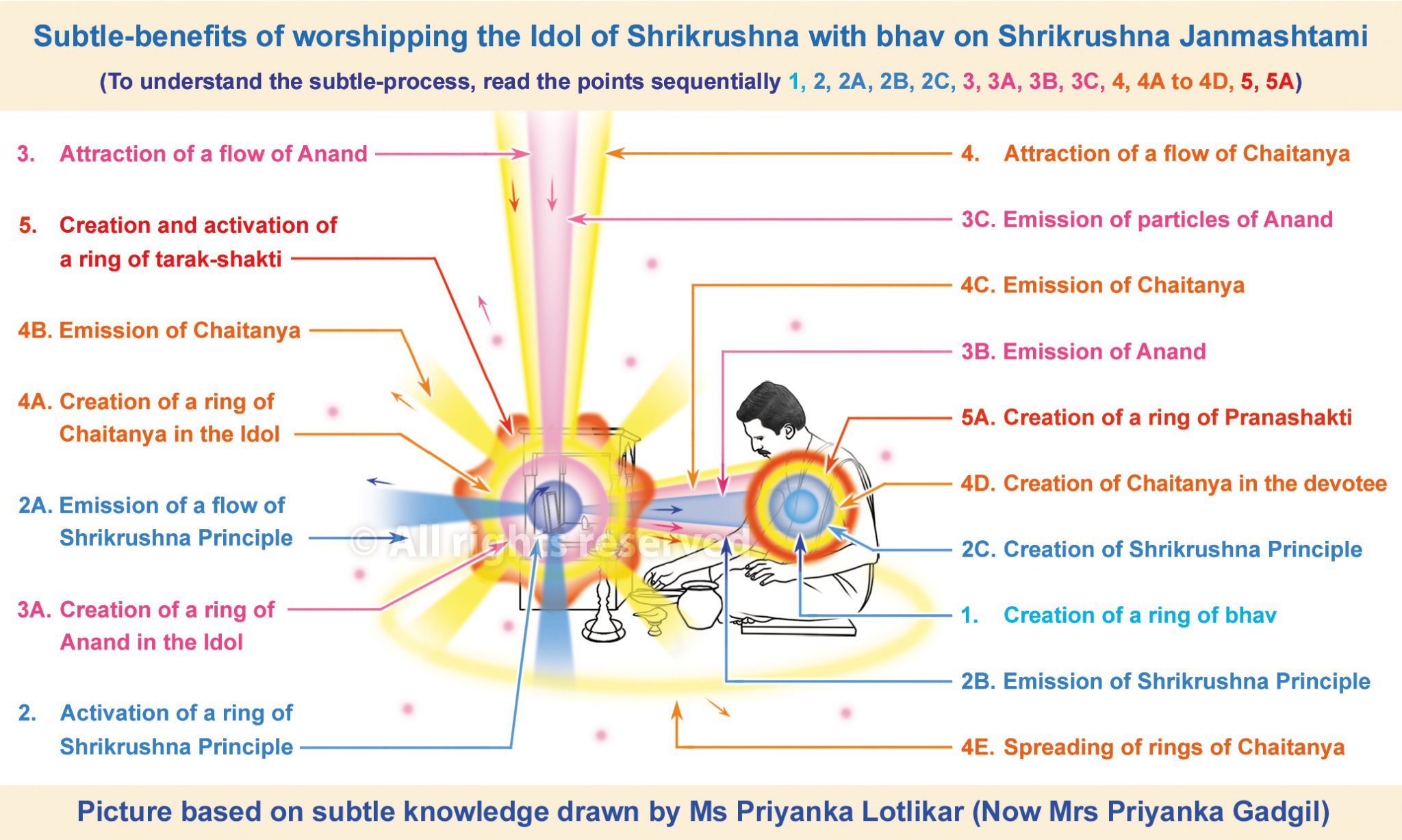
Purpose behind publishing ‘subtle-knowledge based readings’ and ‘subtle-knowledge based pictures’
Most people do not have the capacity to know what effect a gross action has in the subtle after we perform it. When the subtle effect is understood, faith is generated towards the gross action. Also, due to subtle-knowledge based pictures, the difficult parts of theoretical knowledge (information) become easy to understand. For this very reason, ‘subtle-knowledge based readings’ and ‘subtle-knowledge based pictures’ are published.
Definition of subtle-knowledge based picture and other analysis
A. Experiential vibrations in a subtle-knowledge based picture
Vibrations such as energy (Shakti), spiritual emotion (Bhav), divine consciousness (Chaitanya), bliss (Anand), peace (Shanti), etc., in a subtle-knowledge based picture are related to the subject of the subtle-knowledge based picture. The components in the subtle-knowledge based picture manifest through these vibrations.
B. Reason for not showing vibrations of peace in a subtle-knowledge based picture
In the vibrations of peace, there is generally a proportion of 70 percent unmanifest (Nirgun) and 30 percent manifest (Sagun). Therefore, even if the subtle-artist has mentioned those vibrations in the context of the picture, meaning even if they feel those vibrations, they are not shown in the subtle-knowledge based picture because they are not visible to their subtle-vision.
C. Good or bad vibrations in a subtle-knowledge based picture
Good or bad vibrations in a subtle-knowledge based picture are the combined effect of all the vibrations absorbed by the subtle-artist based on factors such as the subtle-artist’s capacity to perceive in the subtle, the extent of spiritual distress if any, their spiritual emotion, etc. Due to this, there can be a difference between the observations (regarding vibrations) of two subtle-artists.
D. Good or distressing effect felt by the person looking at the subtle-knowledge based picture
Based on the good or distressing vibrations in the subtle-knowledge based picture and the state of the subtle-artist, the person looking at that subtle-knowledge based picture feels a good or distressing effect.
E. The subtle-artist seeing, feeling, and understanding the cause-and-effect relationship in the subtle
E 1. The form, colour, and shape of subtle vibrations are visible to the subtle-organs of vision, meaning the subtle-eyes. The subtle-organs of action, e.g., the mind, feels whether it is good/distressing, etc., in the subtle. The subtle-intellect perceives the cause-and-effect relationship of the vibrations in the subtle.
E 2. This capacity differs from person to person.
E 3. Seeing the form and colour of the subtle vibrations of an object is related to the Absolute Fire element (Tejtattva). Feeling whether it is good or distressing, etc., is related to the Cosmic Mind (Vishwaman), while obtaining knowledge about it is related to the Cosmic Intellect (Vishwabuddhi).
– Mrs. Priyanka Suyash Gadgil (Sanatan seeker and subtle-artist, Maharshi Adhyatma Vishwavidyalay)
Introduction of the seeker subtle-artist
Mrs Priyanka Suyash Gadgil (nee Lotlikar) started spiritual practice in 1995 at the age of 10. In May 2007, she obtained a diploma in ‘Commercial Arts’ and immediately started serving full-time at Sanatan’s Ashram in Ramnathi (Goa). Since 2001, she has been performing the seva of subtle-knowledge based reading and subtle-knowledge based drawing of religious rituals, various conducts, programs of Saints, etc., under Gurudev’s guidance.
 Sachchidananda Parabrahman (Dr) Athavale – an unparalleled and incarnate being in my eyes
 Spiritual science underlying certain changes in Sachchidananda Parabrahman Dr Athavale’s body
 Ardent views of seekers about Paratpar Guru (Dr) Athavale’s captivating smile
 Paratpar Guru (Dr.) Athavale learns the science underlying every action with curiosity !
 Incessant efforts of Paratpar Guru (Dr.) Athavale day and night to remove the spiritual distresses...
 A great personage who despite being in the highest spiritual state continuously remains in the...