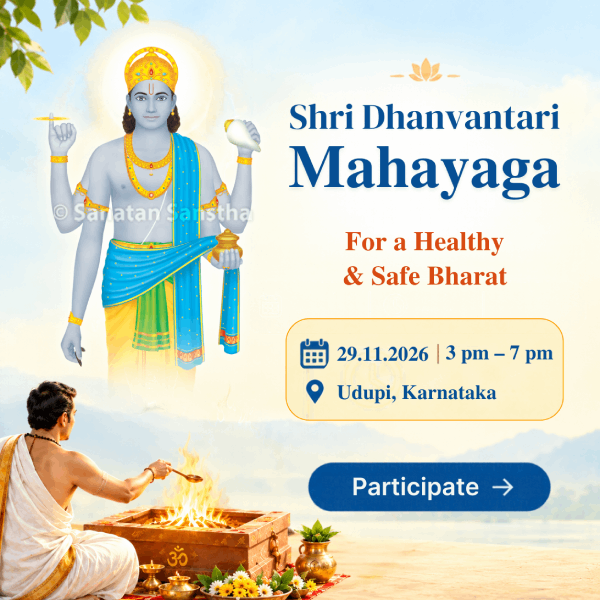

In Indian culture, a Yajna is not merely a religious ritual; it is a confluence of the worship of deities, the power of mantras, spiritual practice and the welfare of society at large. Since the Vedic era, several distinctive Yajnas, such as Ashwamedha, Rajasuya, Somayaga and Vajapeya, have been performed. Each Yajna has its own presiding deity principle, mantras, sacrificial offerings (havirdravya), resolve (sankalpa) and scriptural methodology. As the traditions of many rare Yajnas are gradually fading over time, it is essential to preserve and revive this ancient knowledge. With this very objective, inspired by Sachchidananda Parabrahma Dr. Jayant Athavale, Sanatan Sanstha has, to date, performed more than 300 Yajnas and over 1,000 religious rituals under the guidance of Saints and learned priests.
Organising rare Yajnas, preserving ancient knowledge and conducting scientific research!
Among the Yajnas organised by Sanatan Sanstha, the Sagnichit Ashwamedha Mahasomayaga performed in 2012 at Barshi (District Solapur), under the guidance of Ashwamedhayaji Param Pujya Nana Kale Guruji, deserves special mention. In addition, several distinctive Yajnas have been organised, including Shri Mahasudarshan Yaga, Shri Bagalamukhi Yajna, Mahachandi Yaga, Maharudra Yaga, Shri Tripurasundari Lalitamba Yajna, Shri Rajamatangi Devi Yajna, Panchamahabhutatattva Yaga, Rishi Yaga, Garudapanchakshari Yajna, Pitru Yaga and Shri Ugrapratyangira Yaga. These Yajnas have also benefited from the guidance of Saints such as Param Pujya Das Maharaj, Param Pujya Rambhau Swami and Param Pujya Aba Upadhye.
The tradition of Yajnas is preserved not merely by organising them, but also by passing on the science underlying them to future generations. Nowadays, progressive thinkers and atheists often criticise Yajnas, saying, ‘Ghee, fragrant substances and rare medicinal herbs are burnt during Yajnas, wasting crores of rupees. This money should instead be spent on the poor, farmers and education.’ However, Sanatan Sanstha has given a fitting response to this criticism by demonstrating the science underlying Yajnas through modern equipment, while also maintaining faith in the tradition.
The Sanstha has conducted an in-depth study of Yajnas using modern scientific instruments such as the ‘UAS’ (Universal Aura Scanner). Scientific research is being carried out and documented on the spiritual experiences arising from Yajnas, the substantial increase in the sattvikta of the surrounding environment and their positive effects on nature. The Sanstha is not merely preserving this research in its records; it is also presenting it at various national and international scientific conferences. Through this, the Sanstha is explaining to society, in modern scientific terminology, that ‘a Yajna is not a waste of money, but an extremely significant scientific activity undertaken for the welfare of society at large and the environment’. Another important aspect of this work is the training of priest-seekers through the Sanatan Purohit Pathshala, with the spiritual attitude of ‘performing priestly duties for God-realisation’.
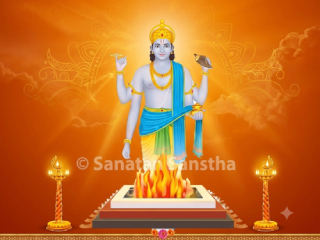
Bhagwan Dhanvantari – The presiding deity of health and Ayurveda!
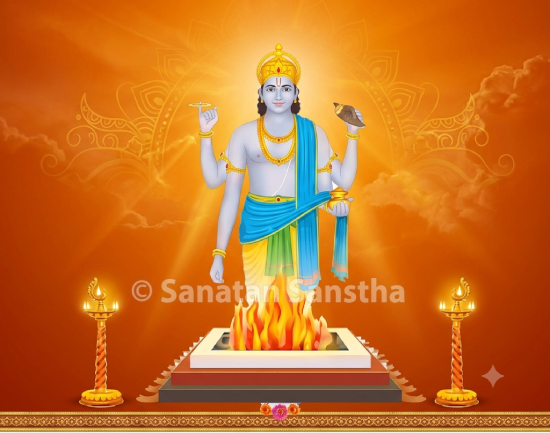
The concept of the 33 crore (33 Koti) deities in Hindu Dharma is associated with the worship of various cosmic energies and principles. Worship of specific deities has been prescribed for different aspects of life, such as intellect, knowledge, wealth, food and health. Bhagwan Dhanvantari is regarded as the presiding deity of Ayurveda. The Shrimad Bhagavat describes His manifestation during the churning of the ocean, holding a pot of Amrit (divine nectar). Bhagwan Dhanvantari, an incarnation of a part of Bhagwan Vishnu, imparted the knowledge of Ayurveda to humanity for the preservation of health and the treatment of diseases. Therefore, His worship is considered important not only for physical well-being but also for mental and spiritual welfare.
Mahayagya organised amidst wars, natural disasters and pandemics!
At present, challenges such as war-like situations across the world, instability in various countries, natural disasters, irregularities in weather patterns and infectious diseases are increasing. Several visionary Saints have cautioned that severe crises may have to be faced in the future. In such circumstances, apart from protecting the health of society, it is essential that people receive spiritual strength for the service of the nation and Dharma. With this wide-ranging resolution, the ‘Shri Dhanvantari Mahayagya’ is being organised at Shri Krishna Kshetra, Udupi, Karnataka.
Through this Mahayagya, a collective prayer will be offered at the feet of Bhagwan Dhanvantari. The underlying sentiment is that people should be blessed with good health of the body, mind and intellect; receive the strength to overcome illnesses and mental stress; and develop the ability to pursue spiritual practice and serve the nation. This is an important opportunity to pray not only for individual well-being but also for the health of society as a whole through the medium of a Yajna.
Let us participate in this Mahayagya with devotion, praying that, by the grace of Bhagwan Dhanvantari, everyone is blessed with a healthy life, society receives the spiritual strength to face the challenges ahead, and India, along with the entire world, is blessed with welfare and prosperity!
Venue: M.G.M. Ground, Kunjibettu, Udupi–Manipal Road, Udupi, Karnataka
Date: 29 November 2026
Time: 3 p.m. to 7 p.m.
Contact: 9113080978 / 7058885610
 Eminent Mumbai advocate Uday Warunjikar pays courtesy visit to Sanatan Ashram in Goa
 Sanatan Sanstha submits memorandum to Censor Board over distortions in the film ‘Ramayana’
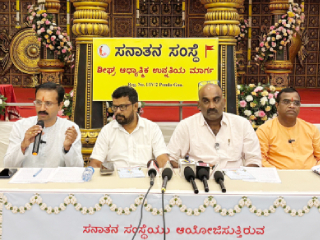 Shri Mahadhanvantari Yag: More than 9,000 devotees registered so far
 Bhoomipujan performed at the venue of Shri Mahadhanvantari Yag in Udupi, Karnataka
 Shrichitshakti (Smt.) Anjali Gadgil honoured at Shri Krishna Janmabhoomi Mukti Rath Yatra concluding ceremony in...
 Sanatan Sanstha objects to distortions in the film ‘Ramayana’