

Widespread misconceptions regarding Adhyatma (Spirituality) and Sadhana (Spiritual practice) have spread over the last century. This is due to so-called “Westernised” social reformers, those claiming to be “science-oriented,” people who cry “superstition” without understanding the nature of shraddha, and “secular” rulers who failed to provide Dharma-shikshan (Education on Dharma) to society. Charlatans have exploited this void, causing these misconceptions to take firm root. Rather than having a true understanding of Spirituality, many people, especially the youth fall prey to these misconceptions. Here, we analyse some of the misconceptions, or in other words, understand “What Spirituality should not be confused with.”
Addressing these misconceptions to help seekers follow the true path of sadhana.
1. Unfair Exploitation
Approximately 30% of people turn spirituality into a business for financial gain. They do this by setting up “study circles” for Yoga or Pranayam. At one such centre, classes were offered under 18 different themes, including concentration, health, and personality development. To attract participants, all 18 course titles were prominently featured in their brochure; however, in reality, the exact same discourse on Pranayama was delivered in every class, with no distinction whatsoever between them.
2. Fraud
Nearly 98% of so-called “Sadhus” exploit the appearance of Saintliness for financial gain. When individuals approach them with personal grievances, some prescribe highly inappropriate and misleading “solutions.” For example, a woman seeking guidance may be told that practices such as yonipuja are the only remedy. Others distribute talismanic threads, claiming they can address worldly concerns like academic success or employment. In doing so, they not only deceive society but also foster passivity rather than encouraging sincere effort or genuine spiritual growth.
This misuse of spiritual authority extends further. Some “Gurus” advertise in newspapers, announcing that they will impart a Guru-mantra at a specified time, while others openly commercialise the process, offering initiation for a fixed fee. Such actions reduce the sacred Guru-disciple tradition to mere transactions.
Those who adopt the external symbols of spirituality (like sporting sandalwood tilak) and call themelves “sadhus”, must understand that true reverence cannot be demanded, it must be earned through righteous conduct. They should live in a manner that naturally inspires respect. Only then can they progress toward their own spiritual liberation.
3. Intellectual arrogance
Roughly a third of individuals in society, despite having no real study or understanding of spirituality, assume the role of experts and set out to “reform” spirituality. They often make strong assertions while lacking even a basic grasp of foundational concepts. Statements are made claiming that Shri Ram was never an ideal or an seat of faith, and that the very concept of God should be uprooted. Some even go so far as to suggest that it is time to “retire” God.
Such claims reflect a profound misunderstanding of spirituality and highlight the risks of speaking on subjects without adequate knowledge or inner experience.
4. “What is the use for us?”
Approximately half the people believe that spirituality is only for those with a particular inclination toward it, often asking, “What relevance does it have in my life?” This stems from a lack of awareness about the deeper causes of human suffering. In the life of an average individual, only about 20% of physical and mental problems arise from non-spiritual factors, such as kriyamankarma (wilful actions). The remaining 80% are rooted in spiritual causes.
This implies that four out of five individuals experiencing distress can attain lasting relief only through Sadhana. In other words, a significant majority of our family members, neighbours, relatives, and friends are, knowingly or unknowingly, in need of spirituality.
Moreover, spiritual practice enhances one’s capacity to endure prarabdhabhoga (destiny). From a worldly standpoint, it helps one cope with life more effectively; from a higher perspective, it is indispensable. For the attainment of moksha (liberation), there is simply no alternative to spirituality.
5. Secrecy
Some believe that spirituality is deliberately shrouded in secrecy.
In response to the question of why followers of Arya Dharma do not openly reveal paramarthata (the supreme spiritual truth), Shri Gulabrao Maharaj offered a thoughtful explanation:
“Those who hold such views often mistake vedanta to be merely a subject for intellectual discussion. Even in worldly pursuits, there exists the concept of ‘krayarahasya’ (trade secret); why, then, should paramarthata be any different? Moreover, no matter how extensively something is described in books, it cannot be truly understood in that manner. Scriptural knowledge also frequently falls into the hands of the anadhikari (those who are not spiritually qualified). This gives rise to individuals who, without genuine practice or realisation, simply read and begin to preach. When such Knowledge becomes cheap and commonplace, people begin to value worldly matters more than spiritual truth.”
If you have any questions about spirituality or wish to complement your daily activities with simple spiritual practices, you can join our free online Satsang to receive guidance and answers. Click and register on – https://events.sanatan.org/
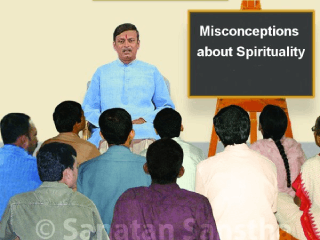 Misconceptions that could mislead seekers on Spirituality
 Frequently Asked Questions about ‘Hindu Rashtra’
 FAQs related to Gurukrupayoga
 Frequently Asked Questions on Guru (Spiritual guide) and Disciple
 FAQs regarding darshan (viewing) in a Devalay (Temple)