

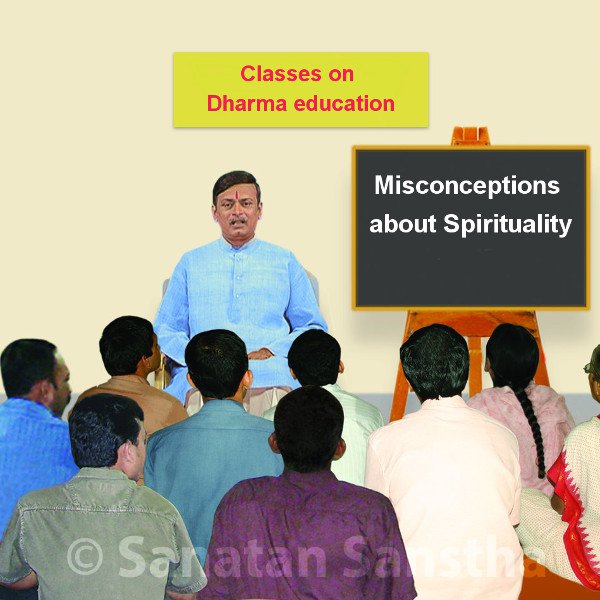
Widespread misconceptions regarding Adhyatma (Spirituality) and Sadhana (Spiritual practice) have spread over the last century. This is due to so-called “Westernised” social reformers, those claiming to be “science-oriented,” people who cry “superstition” without understanding the nature of shraddha, and “secular” rulers who failed to provide Dharma-shikshan (Education on Dharma) to society. Imposters have exploited this void, causing these misconceptions to take firm root. Rather than having a true understanding of Spirituality, many people, especially the youth fall prey to these misconceptions. Here, we analyse some of the misconceptions, or in other words, understand “What Spirituality should not be confused with.”
1. Fear
About 30% of people believe that if Deities, Sadhus, or Saints become angry for some reason, they will suffer. Out of fear, some people forward chain letters/emails/WhatsApp forwards sent in the name of a Deity or Saint, believing the warning that “failure to send this to 25–50 people will cause great harm.” Others give alms to someone in the garb of a Sadhu out of fear that the person might think ill of them or utter a curse. There is no reason to harbour such fears.
There is an indirect benefit that arises from this misconception – the fear of being punished by God for some wrongdoing (resulting in sin) keeps them from straying.
2. Ignorance
Literacy and spiritual ignorance
Secular education has no bearing on spiritual ignorance. In every group, whether non-literate, primary or secondary schooled, graduates, or postgraduates, nearly 90% of individuals remain ignorant about Spirituality. Here are a few examples below:
A. A newspaper article titled “Ganesh Murti – An Aesthetic Perspective” illustrates this ignorance. A famous artist wrote, “The traditional Murti of Ganesh is considered a masterpiece of sculptural beauty. One must admire the creativity of the unknown artist who first realized this concept.” Calling Ganapati a “concept” reflects ignorance. The author did not realise that Deities like Ganapati are not imaginary; they actually exist and possess form.
B. Sachchidananda Parabrahman (Dr) Jayant Athavale was once invited to Mumbai for a discourse on Spirituality. The organisers asked Him, “Do you need a Chaurang (a small square wooden stool like platform) to sit on? Do you need a saffron cloth on the table? Do you need an oil lamp nearby?” They did not realize that Spirituality does not reside in external appearances; it is the “inner self” that must be colored saffron (with Vairagya or detachment).
C. Ignorance regarding Sexuality and Spirituality
A seeker once asked Her Guru, “You tell me to turn toward Spirituality, yet you say ‘sexual life should be normal; do not say no to your husband.’ Isn’t this against Spirituality?” Sexual life does not hinder Spirituality. Saints like Saint Tukaram, Saint Eknath, and event Saint Bhaktaraj Maharaj had children even after attaining Sainthood. The perspectives behind this are:
1a. In Hathayoga, controlling desires is vital; however, in Bhaktiyoga, it is not given the same emphasis. When a practitioner of Bhaktiyoga reaches the state of “Present in the world, yet the mind remains at His feet,” they can live spiritually while performing all worldly duties.
1b. If a seeker’s Namjap is continuous, their actions become akarma karma(action without attachment). Since such actions do not incur the “stain” of the fruits of action, they do not create bondage.
1c. As one’s spiritual level increases, personal will (sweccha) transforms into following the will of others (pareccha), and eventually into God’s will (Ishwareccha). Therefore, whatever happens at the level of Saints usually happens according to God’s will.
1d. Prarabdha (Destiny) must be exhausted by experiencing it; hence, Saints usually do not interfere with destiny.
2. A depressed woman felt her sexual desire had decreased due to age. In reality, it can decrease due to age, depression, or spiritual progress.
3. Sri Aurobindo observed: “Spiritualists separated Spirituality from the world. They ignored the world, calling it Maya (Illusion). This ended the zest for life. People became helpless and passive, living inactive lives in the name of Moksha (Liberation). This is not true Dharma.” (This describes those performing only vyashti sadhana. In reality, a spiritualist’s life should be nourishing to creation.)
4. Fatalism: H.H. Kane Maharaj of Narayangaon stated: “Those who believe in Prarabdha are called ‘fatalists’ or ‘cowards,’ but that is wrong. Such a person is truly brave and worthy of becoming a Saint.”
3. Superstition
The following examples show how deeply superstition is rooted in the Indian psyche:
A. Vrindavan in North India is a holy land sanctified by the presence of Bhagwan Sri Krishna. Residents believe that dying in such a holy place ensures the soul’s liberation. Consequently, there is a “superstition” that residents of Vrindavan will never suffer from distress due to dissatisfied departed ancestors. If this were true, every corrupt person or murderer would simply go there to die and be liberated! That would be an injustice to others, and God is never unjust. Liberation upon death in Vrindavan is for the devotee or the truly repentant sinner, not for everyone.
B. In Maharashtra, many devotees of Sai Baba, particularly from one specific sect, revere a Pomeranian dog. They believe Sai Baba appeared to his disciples as a dog during his lifetime and returned to Earth as this Pomeranian. During its life, this “Shwan-Baba” (Dog-Baba) was carried in a silver palanquin every Thursday and on festival days. After its death, devotees built a Samadhi (Shrine) for it, where it is still worshipped with the same faith.
However, one must consider: If Sai Baba wished to perform a mission on Earth, why would he take the form of an animal? He could more easily liberate souls in human form. While God has taken animal incarnations like Kurma(Tortoise) or Varaha (Boar), those had specific purposes and occurred in Satyayug. In Satyayug, humans had higher Sattvikta (Purity) and could understand the language of animals. In the current Kaliyug, this is not possible. God always takes an incarnation that is necessary and complementary to the times. Thus, a Saint incarnating as a dog is undoubtedly an incorrect notion.
C. We believe “it is an ill omen if a cat crosses one’s path.” Should a cat never cross some path? People get distressed if a lizard falls on them. These are not just beliefs but indicative events. In such cases, one should simply take God’s name.
About 20% of the population cona be considered superstitious. While it causes 10% harm to society, it also provides a 20% benefit, as some people avoid committing evil acts out of fear arising from their superstition.
 The difference between claiming and being a Guru
 Frequently Asked Questions about ‘Hindu Rashtra’
 FAQs related to Gurukrupayoga
 Frequently Asked Questions on Guru (Spiritual guide) and Disciple
 FAQs regarding darshan (viewing) in a Devalay (Temple)